
Introduction (AI vs Automation): Why So Many Businesses Are Confused
Right now, many businesses feel stuck.
They hear words like AI, automation, machine learning, and smart systems every day. Sales pages promise faster work, lower costs, and more growth. But when business owners try to use these tools, they often feel confused or disappointed.
One of the biggest reasons is simple:
Most people do not clearly understand the difference between AI and automation.
Some think they are the same thing.
Some think automation is old and AI replaces it.
Others buy expensive tools without knowing what problem they are solving.
This blog will clear everything up.
Why Businesses Keep Mixing Up AI and Automation
Most businesses mix up AI and automation because the industry markets them together.
Software companies often say:
- “AI automation platform”
- “Smart automation”
- “AI-powered workflows”
But they rarely explain what part is AI and what part is automation.
Because of this:
- Businesses buy tools they don’t need
- Teams expect AI to magically fix broken processes
- Automation gets blamed when AI fails
- AI gets blamed when automation breaks
The truth is simple:
AI and automation are different tools.
They solve different problems.
But they work best when used together.
To understand this, we need to look at each one separately.
What Automation Really Is (Without AI)
Automation is the oldest and simplest of the two.
Automation means:
A system that follows fixed rules to complete tasks automatically.
Automation does not think.
Automation does not decide.
Automation only does what it is told to do.
Simple Examples of Automation
- Sending an email after a form is submitted
- Moving a lead to another stage in a CRM
- Creating an invoice after payment
- Sending appointment reminders
If this happens → then do that, that is automation.
Strengths of Automation
- Very fast
- Very reliable
- Very cheap
- Great for repetitive tasks
Automation is perfect for work that:
- Happens again and again
- Follows the same steps every time
- Does not require judgment
Limits of Automation
Automation breaks when:
- A situation changes
- Input is messy or unclear
- Decisions are required
Automation cannot:
- Understand language
- Handle exceptions well
- Learn from mistakes
That is where AI comes in.
What AI Really Is (Without Automation)
AI is very different.
AI means:
A system that can understand, predict, or decide based on data.
AI can:
- Read text
- Understand speech
- Analyze patterns
- Make decisions
But here is something most people miss:
AI by itself does nothing useful in daily operations.
AI can think, but it does not act unless connected to automation.
Simple Examples of AI
- Chatbots that understand questions
- Voice agents that understand callers
- AI that scores leads
- AI that writes responses
Strengths of AI
- Handles messy data
- Understands human language
- Learns over time
- Adapts to new situations
Limits of AI
AI alone:
- Does not execute workflows
- Does not move data
- Does not trigger actions
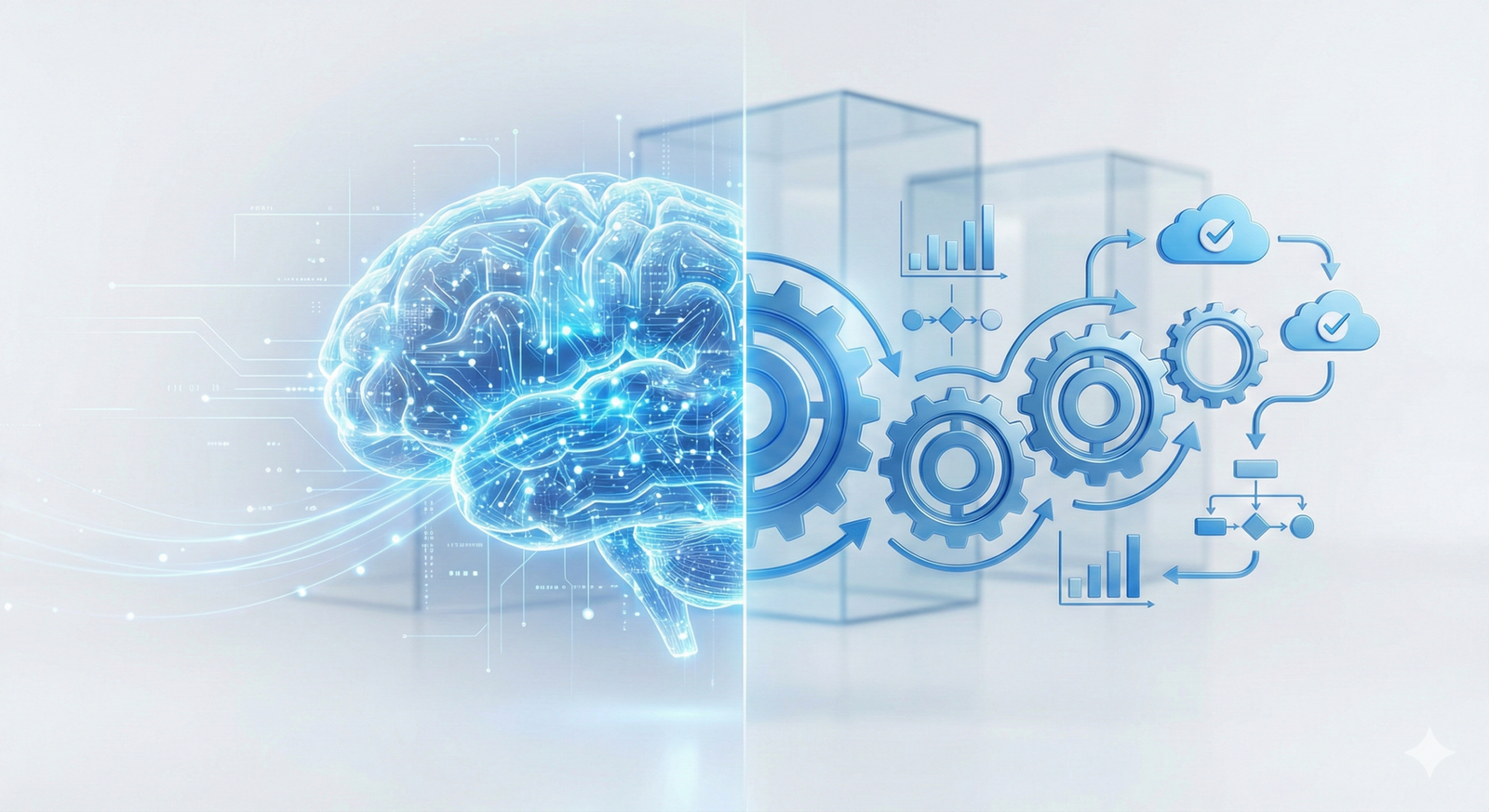
AI is the brain.
Automation is the body.
AI vs Automation : A Side-by-Side Comparison
Let’s compare AI vs automation clearly.
Decision Making
- Automation: No decisions
- AI: Makes decisions
Flexibility
- Automation: Rigid
- AI: Flexible
Learning
- Automation: Never learns
- AI: Improves with data
Speed
- Automation: Extremely fast
- AI: Fast but depends on complexity
Best Use
- Automation: Repetitive tasks
- AI: Judgment-based tasks
Risk
- Automation: Breaks when rules fail
- AI: Can make wrong decisions without guidance
This comparison shows why neither is enough alone.
Why Automation Alone Fails in Real Businesses
Many businesses start with automation only.
At first, it works well.
But then:
- Customers ask unexpected questions
- Data formats change
- Leads behave differently
Automation does not know how to adapt.
So businesses end up:
- Adding more rules
- Creating complex workflows
- Spending more time fixing automation
Eventually, the system becomes fragile.
Why AI Alone Also Fails
Some businesses jump straight to AI.
They add:
- Chatbots
- Voice agents
- AI writers
But without automation:
- AI answers but does nothing
- AI understands but does not act
- Humans still have to complete tasks
This creates:
- More work, not less
- Confusion in teams
- Inconsistent processes
AI without automation is intelligence without execution.
How AI and Automation Work Together in Business
This is where the magic happens.
How They Combine
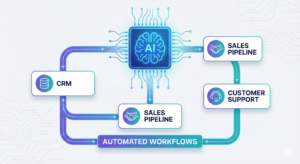
- AI understands input
- AI makes a decision
- Automation executes actions
Example:
- AI understands a customer message
- AI decides it is a sales inquiry
- Automation books a meeting
- Automation sends confirmation
- Automation updates the CRM
No human needed.
This is AI automation done correctly.
Real Business Examples of AI vs Automation

Customer Support
- AI understands customer issues
- Automation routes tickets
- Automation sends updates
Sales
- AI qualifies leads
- Automation assigns sales reps
- Automation sends follow-ups
Phone Calls
- AI voice agent answers calls
- Automation books appointments
- Automation logs call data
Operations
- AI detects issues
- Automation triggers workflows
- Automation alerts teams
This is how modern businesses scale.
Where Businesses Should Start Using AI + Automation
Do not automate everything at once.
Start with:
- Repetitive tasks
- High-volume work
- Clear business impact
Best starting points:
- Lead handling
- Appointment booking
- Customer support
- Follow-ups
Start small. Improve. Then expand.
AI vs Automation for Small Businesses
Small businesses benefit the most.
Why?
- Limited staff
- Limited time
- Limited budget
AI and automation:
- Reduce manual work
- Improve response speed
- Compete with larger companies
You do not need a big team to run smart systems.
How to Decide What Needs AI vs Automation
Ask these questions:
Use Automation If:
- The task follows rules
- No decision is needed
- The process is stable
Use AI If:
- Judgment is required
- Language is involved
- Situations change
Use Both If:
- Decisions lead to actions
- Customers are involved
- Speed matters
This simple test avoids failure.
The Role of AI Automation Companies
Most businesses fail because:
- They automate broken processes
- They use the wrong tools
- They skip strategy
- Analyze workflows
- Design smart systems
- Combine AI and automation correctly
This saves time, money, and frustration.
The Future of AI vs Automation in Business

The future is not AI alone.
The future is not automation alone.
The future is AI + automation working together.
Businesses that understand this will:
- Move faster
- Spend less
- Serve customers better
Those who don’t will fall behind.
Common Myths About AI vs Automation
Myth 1: AI replaces all jobs
Reality: It removes boring work.
Myth 2: Automation removes control
Reality: It increases consistency.
Myth 3: AI is too expensive
Reality: Not using it costs more.
Myth 4: Only tech companies need this
Reality: Every business does.
Key Takeaways
- AI vs automation is not a competition
- Automation executes
- AI decides
- Together, they create real business results
Final Thoughts – AI vs Automation
Understanding AI vs automation is no longer optional.
It is a business skill.
Those who learn how they work together will build stronger, faster, and smarter companies, without burning out their teams.


