
The Conversation Problem Most Businesses Don’t Notice
Customers talk to businesses differently than they did ten years ago.
Before, a customer might call a business, speak with a receptionist, and ask questions about a service.
Today, customers communicate through many channels at the same time.
They might send a message through a website chat.
They might text the business phone number.
They might call directly.
They might send a message through social media.
The result is simple.
Businesses now receive more conversations than ever before.
At first this sounds like good news. More conversations mean more opportunities. But it also creates a new challenge.
Many businesses cannot respond quickly enough.
A customer might send a message and wait. If they do not receive a reply quickly, they move on and contact another company.
In many industries, speed of communication now determines who wins the customer.
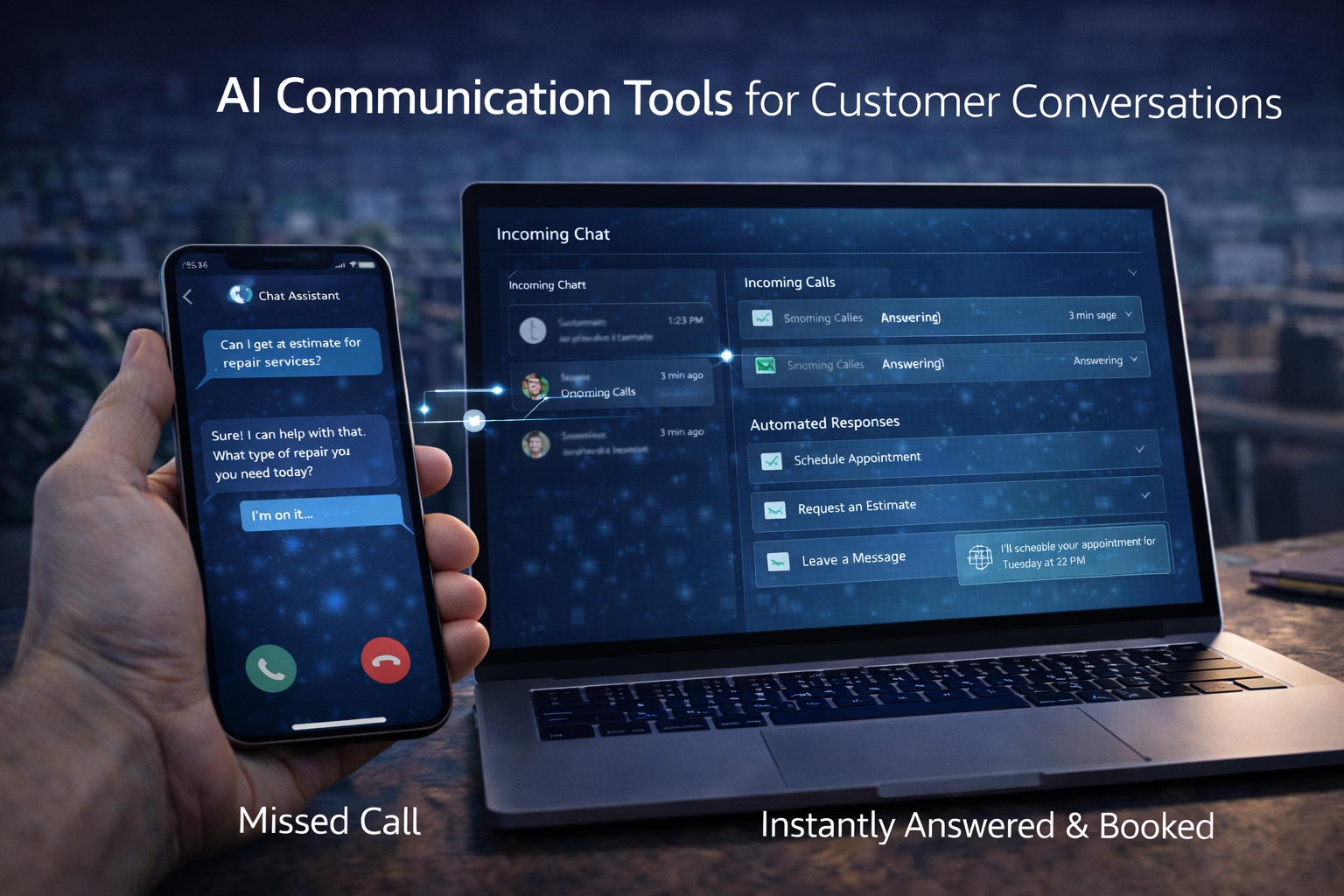
That is why companies are turning to AI communication tools to automate conversations and respond instantly.
These tools help businesses stay connected with customers even when teams are busy or unavailable.
What AI Communication Tools Actually Are
AI communication tools are systems that help businesses manage conversations automatically.
Instead of requiring someone to respond manually to every message or phone call, these tools use artificial intelligence to handle many interactions.
A typical AI communication system can:
Respond to website chat messages
Answer incoming phone calls
Reply to text messages
Guide customers through questions
Collect contact details
Schedule appointments
The purpose is not to remove human interaction completely. Instead, the goal is to handle routine conversations automatically so businesses never miss an opportunity.
When customers receive quick responses, they are more likely to continue the conversation and eventually become paying customers.
AI communication tools make this possible at scale.
Why Businesses Are Turning to Communication Automation
Customer expectations have changed dramatically in recent years.
People expect fast responses.
When someone contacts a business today, they usually expect a reply within minutes, not hours.
This shift in expectations has created pressure for businesses to improve their communication systems.
There are several reasons why companies are adopting AI communication tools.
Customer expectations are higher
Customers are used to instant replies from messaging apps and online platforms.
When a business responds slowly, it feels outdated.
Teams are already busy
Employees often have many responsibilities. Answering every call or message immediately is difficult.
Conversations happen outside business hours
Many customer inquiries arrive in the evening or on weekends.
Missed conversations mean lost revenue
When businesses fail to respond quickly, customers often contact competitors.
AI communication tools solve these problems by responding instantly.
The Different Types of AI Communication Tools
AI communication tools come in several forms. Each type focuses on a different communication channel.
Understanding these categories helps businesses choose the right solution.
AI Chatbots
AI chatbots are commonly used on websites.
When a visitor opens a website and asks a question, the chatbot responds immediately.
Chatbots can answer common questions such as:
What services do you offer
What are your business hours
How can I schedule an appointment
More advanced chatbots can also collect contact details and guide customers through service requests.
This ensures that website visitors receive help immediately.
AI Voice Agents
AI voice agents handle phone calls automatically.
Instead of sending callers to voicemail, the system answers the phone and begins a conversation.
Modern AI voice systems can greet callers, ask questions, and collect important details.
For example, an AI voice agent might ask:
What service are you looking for today?
What is the location of the project?
When would you like the appointment?
These conversations allow businesses to qualify leads automatically.
AI Messaging Automation
Many businesses communicate with customers through text messages.
AI messaging tools can respond instantly to SMS or messaging app inquiries.
These systems can send confirmations, reminders, or follow-up messages without requiring manual input.
This helps businesses maintain consistent communication.
AI Email Response Systems
AI tools can also assist with email communication.
They can recognize common inquiries and generate helpful responses.
While human teams often review important emails, automation helps manage large volumes of messages efficiently.
How AI Communication Tools Actually Work
Behind every automated conversation is a combination of several technologies.
These technologies allow AI systems to understand messages and generate responses.
Natural Language Processing
Natural language processing allows the AI to understand the meaning of customer messages.
Instead of reacting to specific keywords, the system analyzes the intent of the message.
For example, if a customer writes:
“I need someone to fix my driveway.”
The AI understands that the customer is requesting a service.
Conversation Automation
Once the AI understands the request, it guides the conversation.
The system may ask follow-up questions to gather more details.
This process allows businesses to collect useful information before a human team member becomes involved.
AI Voice Technology
AI voice systems convert text responses into spoken language.
The most advanced systems sound natural and conversational.
This technology allows businesses to automate phone conversations effectively.
Workflow Integration
AI communication tools often connect with other systems used by businesses.
These integrations allow the AI to:
Check appointment availability
Schedule meetings
Store lead information
Send follow-up messages
By connecting conversations with workflows, businesses create a seamless customer experience.
The Business Benefits of AI Communication Tools
Companies that implement AI communication tools often notice several improvements.
Faster responses
Customers receive answers immediately instead of waiting for someone to reply.
Improved lead capture
Potential customers are less likely to disappear when conversations begin instantly.
Reduced workload
Employees spend less time responding to routine questions.
Better customer experience
Customers appreciate quick and helpful communication.
Increased conversion rates
More conversations turn into actual customers.
These benefits help businesses grow without increasing staffing costs.
Industries That Benefit the Most
AI communication tools are useful across many industries, but some businesses benefit more than others.
Home service companies
Contractors, landscapers, and repair companies often miss calls while working on job sites.
AI voice agents help answer calls instantly.
Healthcare providers
Medical offices receive large numbers of calls related to appointments and patient questions.
Automation helps manage this demand.
Real estate professionals
Agents often receive inquiries outside normal business hours.
AI tools ensure that these inquiries receive attention.
Local service businesses
Restaurants, gyms, and other local companies benefit from faster communication with customers.
These tools help ensure that every inquiry receives a response.
Why AI Communication Tools Are Becoming Essential
The business environment is becoming more competitive.
Companies that respond quickly have an advantage.
Customers often choose the business that communicates first.
AI communication tools allow businesses to respond immediately across multiple channels.
Instead of relying entirely on human availability, businesses can build systems that maintain constant communication with customers.
This shift helps businesses stay competitive.
How Businesses Are Implementing AI Communication Systems
Many companies start small when implementing AI communication tools.
The first step is identifying where communication delays occur.
Businesses often discover that missed calls or slow responses are causing lost opportunities.
From there, companies introduce automation gradually.
They might begin with website chat automation or an AI voice system for incoming calls.
Once the system proves effective, businesses expand automation to other channels such as messaging or follow-up communication.
This step-by-step approach allows teams to adapt to the technology comfortably.
How FutureForge AI Solutions Helps Businesses Automate Communication
Implementing AI communication tools can feel complex for many businesses.
This is where companies like FutureForge AI Solutions help.
FutureForge focuses on building AI communication systems designed specifically for business workflows.
These systems combine several capabilities:
AI voice agents that answer incoming calls
AI chat systems that respond to website visitors
Automation workflows that collect customer information
Lead qualification processes that identify real opportunities
Instead of simply adding new software, these systems integrate with existing business processes.
The goal is to help businesses respond faster, capture more opportunities, and improve customer experience.
By automating conversations, companies ensure that customers always receive a response.
The Future of AI Communication Tools

AI communication technology is evolving rapidly.
Future systems will likely include even more advanced capabilities.
AI voices will continue becoming more natural and conversational.
Systems will understand context better and provide more personalized responses.
Businesses will also integrate voice, chat, and messaging automation into unified communication platforms.
As these technologies develop, communication automation will become a normal part of running a business.
Companies that adopt these tools early may gain a strong advantage in customer experience.
Final Thoughts
Customer communication has changed dramatically.
People expect fast responses across multiple channels.
Businesses that cannot keep up with these expectations risk losing opportunities to competitors.
AI communication tools help solve this problem.
By responding instantly, guiding conversations, and collecting important details, these systems allow businesses to manage communication more efficiently.
Instead of missing opportunities, businesses can capture and convert more inquiries.
For many companies, adopting AI communication tools is not just about technology.
It is about building a system that ensures every customer conversation begins at the right moment.


