
Introduction
Customer communication has changed dramatically in the past few years. Not long ago, most businesses relied mainly on phone calls and email to talk with customers. Today the situation is very different. Customers visit websites, open chat windows, send messages through social platforms, and expect answers almost immediately.
Think about how people behave online today. When someone visits a website and has a question, they usually want an answer right away. They do not want to wait hours or days for a reply. If they cannot find quick help, they often leave the website and look for another company that responds faster.
This shift in expectations has created a challenge for businesses of every size. Customer inquiries arrive throughout the day, sometimes in large numbers. Sales teams may be busy in meetings. Support agents may already be helping other customers. Small businesses may not have dedicated staff available to answer website messages instantly.
When responses are slow, potential customers often move on to competitors. That means valuable opportunities disappear before a conversation even begins.
Because of this problem, many companies are investing in artificial intelligence chatbots. These systems can respond instantly, answer questions, collect information, and guide visitors toward the next step in the buying process.
However, building an effective chatbot requires more than installing a simple chat widget. Businesses need well-designed automation systems that understand customer questions, connect with business tools, and support real sales processes.
This is why organizations are searching for the right AI chatbot development company.
But choosing the best provider is not always easy. Many companies claim to offer chatbot solutions, yet their capabilities, technology, and experience can vary widely.
This guide explains how businesses can choose the best AI chatbot development company, what features matter most, and how the right automation system can improve customer communication and business growth.
Why Businesses Are Investing in AI Chatbot Development

Before choosing a chatbot provider, it is helpful to understand why businesses are adopting this technology so quickly.
Across many industries, customer communication has become more complex. Businesses now receive inquiries through websites, online ads, messaging apps, social media, and contact forms. Each channel creates more opportunities to connect with customers, but it also increases the workload for support and sales teams.
Without automation, managing these conversations can become overwhelming.
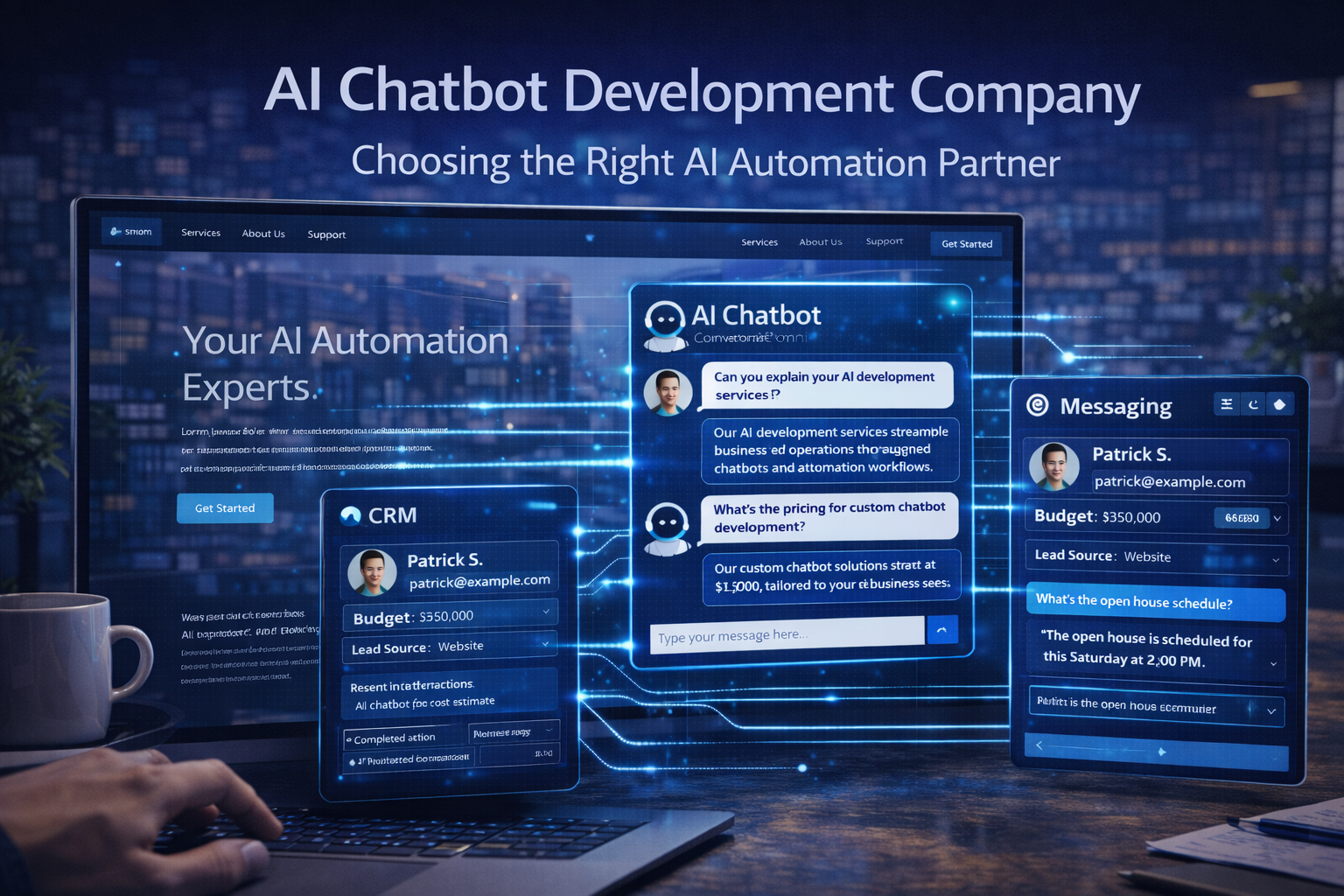
AI chatbots help solve this challenge by handling many conversations automatically. When a visitor opens a chat window on a website, the chatbot can greet them instantly and ask how it can help. The system can answer common questions, collect contact information, or guide the visitor toward booking an appointment.
This immediate response improves the customer experience. Instead of waiting for a reply, visitors receive assistance right away. This keeps them engaged and increases the chance that they will continue the conversation.
Another major advantage is availability. Human teams cannot work twenty-four hours a day. AI chatbots can operate continuously, answering questions and capturing leads even outside normal business hours.
Many companies also use chatbots to reduce the pressure on support teams. Instead of answering the same questions repeatedly, human agents can focus on more complex issues that require personal attention.
As a result, businesses gain faster communication, better lead capture, and more efficient support operations.
These benefits explain why the demand for AI chatbot development services has increased rapidly in recent years.
What an AI Chatbot Development Company Actually Does
Many people assume that chatbot companies only build small chat windows for websites. In reality, modern chatbot development is much more advanced.
A professional AI chatbot development company designs systems that combine artificial intelligence, conversation design, and business automation.
These systems are built to match the way a business communicates with customers.
A good chatbot development process usually begins with understanding how customers interact with the business. Developers analyze typical questions, common support requests, and the steps customers take before making a purchase.
Based on this information, the development team designs conversation flows that guide visitors through helpful interactions.
For example, a chatbot might begin by greeting a website visitor and asking what they are looking for. If the visitor wants information about a service, the chatbot can explain key details and ask follow-up questions to better understand the request.
During this process, the chatbot can collect useful information such as contact details, project requirements, or scheduling preferences.
Modern chatbot systems often connect with other business tools. They may integrate with customer relationship management platforms, appointment scheduling systems, or marketing automation tools. This integration ensures that information collected during conversations becomes part of the company’s broader workflow.
Because every business operates differently, professional chatbot development usually involves building customized automation systems rather than simple templates.
Signs of a High-Quality AI Chatbot Development Company
Choosing the right chatbot provider requires careful evaluation. Businesses should look for companies that demonstrate strong technical skills and a clear understanding of customer communication.
One important sign of a reliable provider is technical expertise. AI chatbots rely on natural language processing and machine learning technologies that allow them to understand human messages. Developers must know how to configure these systems so they respond accurately and naturally.
Another important factor is customization. Every business has unique processes and customer journeys. A good chatbot development company should be able to design systems tailored to those specific needs.
Integration experience is also critical. Chatbots often need to connect with existing tools such as CRM platforms, scheduling software, or marketing systems. Without proper integration, automation may become limited or disconnected from the rest of the business workflow.
Strong communication design is another sign of quality. Chatbots should guide conversations clearly and politely, helping visitors find answers without confusion.
Finally, businesses should look for providers with real industry experience. Companies that have built chatbot systems for service businesses, agencies, or online platforms usually understand practical challenges better than developers who only work with experimental technology.
Key Features Businesses Should Look For in AI Chatbots
When evaluating chatbot providers, businesses should pay close attention to the features included in the system.
One of the most important features is natural conversation design. Chatbots should communicate in a friendly and clear way that feels helpful rather than mechanical.
Lead capture functionality is another important capability. The chatbot should be able to collect information such as names, phone numbers, email addresses, and service requests. This allows the business to follow up with interested prospects.
Smart routing is also valuable. When a conversation requires human attention, the chatbot should be able to transfer the message to the appropriate team member.
Another useful feature is automated follow-up. After capturing a lead, the system can send confirmation messages or reminders that keep communication active.
These features transform chatbots from simple messaging tools into powerful business automation systems.
Questions to Ask Before Hiring an AI Chatbot Development Company
Businesses should ask several important questions before choosing a chatbot provider.
First, it is helpful to ask about previous experience. Developers who have worked with similar industries often understand common customer interactions and can design better conversation flows.
Companies should also ask how the chatbot integrates with existing tools. If the system cannot connect with CRM software or scheduling platforms, it may create additional manual work instead of reducing it.
Another important question involves customization. Businesses should understand how flexible the chatbot is and whether it can adapt to future changes in their processes.
Support and maintenance are also important considerations. AI systems require updates and monitoring to ensure they continue functioning properly.
These questions help businesses identify providers that offer reliable long-term solutions rather than temporary tools.
Custom Chatbots vs Template Chatbots
Many chatbot providers offer two main types of solutions: template chatbots and custom chatbots.
Template chatbots are pre-built systems designed to work with minimal setup. They often include basic conversation flows and simple features. While these tools can be useful for small projects, they may lack the flexibility needed for more advanced automation.
Custom chatbots are designed specifically for a business’s communication processes. Developers create conversation flows tailored to the company’s services, customer journey, and sales strategy.
Custom systems also integrate more easily with existing tools such as CRM platforms and marketing automation software.
Because of these advantages, many growing businesses prefer custom chatbot development. Although the initial setup may require more planning, the result is a system that supports long-term automation and scalability.
How AI Chatbots Improve Lead Generation
One of the most powerful benefits of chatbots is their ability to support lead generation.
When a visitor arrives on a website, they often have questions before making a decision. If those questions remain unanswered, the visitor may leave the site without taking any action.
AI chatbots help prevent this by starting conversations immediately. The chatbot can ask visitors what they are looking for and guide them toward helpful information.
For example, a visitor may want to know about pricing or available services. The chatbot can provide basic details and then ask whether the visitor would like to receive a personalized quote.
During this process, the chatbot collects contact information and other relevant details.
This interaction converts a casual website visitor into a potential lead.
Many businesses find that chatbot conversations significantly increase the number of leads captured from their websites.
How FutureForge AI Solutions Helps Businesses Build Smart Chatbots
FutureForge AI Solutions specializes in building automation systems that help businesses manage customer communication more efficiently.
Instead of focusing only on chat tools, FutureForge develops integrated solutions that combine AI chatbots, voice agents, and workflow automation.
These systems allow businesses to respond instantly to customer inquiries across multiple channels.
For example, if a visitor sends a message through a website chat window, the chatbot can answer questions and collect lead information automatically. If a customer prefers calling instead of messaging, an AI voice agent can respond to the call and gather similar information.
All collected data can then be connected to CRM systems and internal workflows, ensuring that no lead or customer request is lost.
By combining AI technology with practical business processes, FutureForge helps companies create communication systems that operate efficiently around the clock.
Common Mistakes Businesses Make When Choosing Chatbot Developers
Some businesses make the mistake of choosing chatbot providers based only on price. While cost is important, selecting the cheapest option can sometimes lead to limited functionality and poor automation design.
Another common mistake is relying on generic chatbot templates that do not match the company’s workflow.
Businesses should also avoid ignoring integration requirements. A chatbot that does not connect with other business systems may create more manual work rather than reducing it.
Finally, companies sometimes focus too much on technology and forget about the customer experience. Chatbots should be designed to help users easily find answers and take action.
Avoiding these mistakes can lead to much more successful chatbot implementations.
The Future of AI Chatbot Development
AI chatbot technology continues to evolve rapidly. New improvements in artificial intelligence are making conversations more natural and more personalized.
Future chatbots will likely understand context better and remember previous interactions. This will allow businesses to provide more personalized customer experiences.
Integration between chatbots and voice systems is also becoming more common. Businesses are beginning to combine chat automation with AI voice agents so customers can communicate through both messaging and phone calls.
As these technologies advance, chatbots will play an even larger role in customer communication.
Businesses that adopt these systems early will be better positioned to provide faster responses, capture more leads, and build stronger relationships with customers.
Conclusion
Choosing the right AI chatbot development company can significantly improve how businesses communicate with customers.
A well-designed chatbot system can answer questions instantly, capture valuable leads, and automate many parts of the customer journey.
However, businesses should focus on more than just technology. The most effective solutions combine intelligent automation with thoughtful communication design.
By working with experienced providers such as FutureForge AI Solutions, companies can build AI chatbots that improve efficiency, enhance customer experiences, and support long-term growth.
As digital communication continues to evolve, chatbot technology will become an essential part of modern business operations.


