
Introduction
Over the last decade, the way businesses operate has changed dramatically. Companies now rely on digital tools for almost every part of their operations. Customers communicate through websites, mobile apps, social media, and messaging platforms. Sales teams use CRM systems to manage leads. Marketing teams rely on automation tools to send emails and track customer behavior.
While these technologies make businesses more powerful, they also create a new challenge. Managing all these systems manually can quickly become overwhelming.
For example, imagine a service business that receives dozens of inquiries every day. Customers might send messages through a website chat, call the business phone number, fill out contact forms, or ask questions through social media. Each message requires a response, and each potential lead needs to be organized and followed up with.
If the team responds slowly or forgets to follow up with a lead, the opportunity may disappear. The customer may simply contact another company that responds faster.
This is where automation becomes essential.
Automation allows businesses to handle repetitive tasks automatically. Instead of employees manually responding to every message, entering data into spreadsheets, or sending follow-up emails, software systems can perform these tasks instantly.
But these systems do not build themselves. Behind them is a specialist who understands how to connect artificial intelligence tools, automation platforms, and business processes together.
That specialist is known as an AI automation engineer.
An AI automation engineer designs and builds intelligent systems that automate communication, streamline workflows, and help businesses operate more efficiently.
In this guide, we will explore what an AI automation engineer does, what skills they need, how they build automation systems, and why businesses are increasingly relying on this role to scale their operations.
What Is an AI Automation Engineer?
An AI automation engineer is a professional who builds systems that allow businesses to automate tasks using artificial intelligence and software automation tools.
The goal of an AI automation engineer is simple. They help businesses replace repetitive manual work with intelligent systems that operate automatically.
Instead of employees performing the same tasks repeatedly, automation systems can handle these tasks quickly and consistently.
For example, many businesses receive the same types of customer questions every day. Customers might ask about pricing, services, availability, or appointment scheduling. If employees have to answer these questions manually each time, it consumes valuable time.
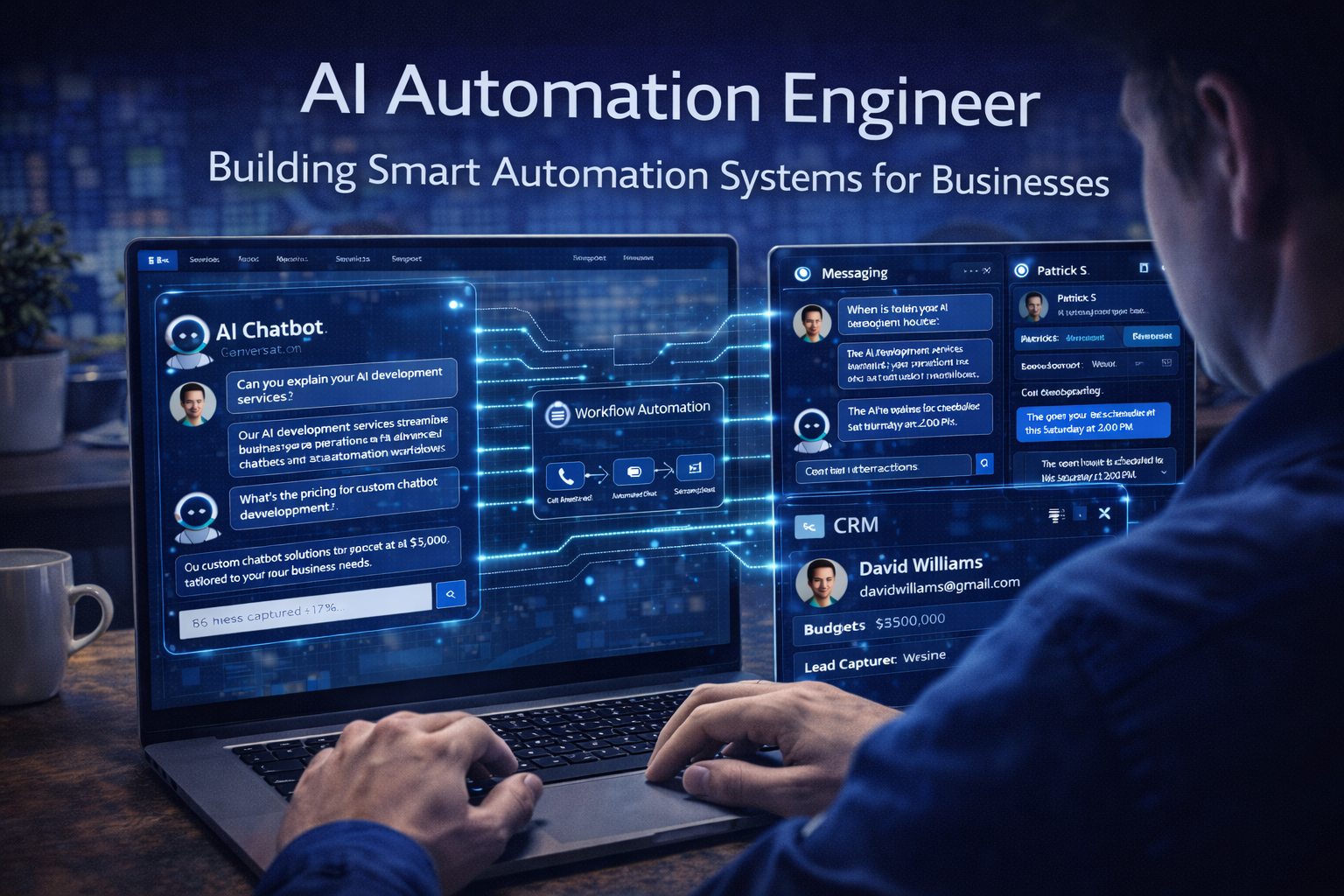
An AI automation engineer can create a chatbot that answers these questions instantly. The chatbot can also collect customer information, qualify leads, and guide visitors toward booking an appointment.
This type of automation not only saves time but also improves the customer experience. Customers receive answers immediately rather than waiting for a response.
In addition to chatbots, AI automation engineers often build voice automation systems that can answer phone calls, collect information, and route calls to the appropriate team member.
They also design workflow automation systems that connect different business tools together. For example, when a new lead submits a form on a website, the system can automatically add the contact to a CRM, notify the sales team, and send a follow-up message to the customer.
These systems allow businesses to operate more efficiently and ensure that important tasks are never missed.
Why Businesses Need AI Automation Engineers
The demand for AI automation engineer has grown rapidly because businesses are becoming more dependent on digital systems.
Every modern company uses multiple software tools to manage different aspects of its operations. These may include customer relationship management systems, marketing platforms, communication tools, and scheduling software.
When these systems are not connected properly, employees often need to perform repetitive tasks manually. For example, they may need to copy customer information from a contact form into a CRM system or send follow-up messages individually to new leads.
These tasks may seem small, but when they happen hundreds of times each week, they consume a significant amount of time.
Automation engineers solve this problem by building systems that connect different tools together.
When automation is implemented correctly, information flows automatically between systems. Customer data is captured instantly, leads are organized automatically, and follow-up messages are triggered without manual work.
This allows employees to focus on more valuable tasks such as building relationships with customers, closing sales, and improving services.
Another important reason businesses hire AI automation engineers is speed.
Customers today expect fast responses. If a visitor asks a question on a website and receives no response for several hours, they may simply leave and contact a competitor.
Automation systems ensure that customers receive immediate responses, even when employees are busy.
This can significantly improve customer satisfaction and increase the number of leads a business captures.
Core Responsibilities of an AI Automation Engineer
AI automation engineers handle several important responsibilities within a business.
Their work involves both technical development and strategic planning.
One of their first tasks is analyzing how a business currently operates. They study communication channels, customer journeys, and internal workflows to identify areas where automation can improve efficiency.
For example, they may observe that customer inquiries are arriving through multiple channels but are not being organized effectively. Leads may be scattered across email inboxes, spreadsheets, and messaging apps.
An automation engineer can design a system that centralizes these inquiries and automatically records them in a CRM system.
Another responsibility involves designing chatbot systems. Chatbots are one of the most common automation tools used by businesses today. An automation engineer builds conversation flows that allow chatbots to interact with customers naturally.
These chatbots can answer common questions, collect contact information, and guide visitors toward scheduling appointments or requesting quotes.
Voice automation is another growing area. AI voice agents can answer incoming calls, ask questions, and record customer information. This ensures that businesses capture leads even when staff members are unavailable.
Automation engineers also connect various software tools so they work together seamlessly. This may involve integrating CRM systems with marketing platforms, scheduling tools, and communication channels.
Finally, automation engineers continuously improve automation systems by analyzing performance and adjusting workflows to make them more effective.
Skills Required to Become an AI Automation Engineer
Becoming an AI automation engineer requires a combination of technical knowledge and business understanding.
One of the most important skills is knowledge of artificial intelligence technologies. Engineers need to understand how AI systems process language and generate responses.
They also need experience with automation platforms that allow workflows to be created without building everything from scratch.
Programming skills are also valuable. Many automation systems require customization or integration with APIs, which involves writing code to connect different platforms.
Another important skill is system integration. Automation engineers must understand how to connect different software tools so they function as part of a unified system.
Equally important is an understanding of business processes. Automation should support real workflows, not disrupt them. Engineers need to understand how businesses operate in order to design useful systems.
Communication skills are also valuable. Automation engineers often collaborate with business owners, marketing teams, and sales teams to understand their needs and design appropriate solutions.
Tools AI Automation Engineers Use
AI automation engineers use a variety of tools and technologies to build automation systems.
Chatbot development platforms allow engineers to create conversational interfaces for websites and messaging platforms.
Automation workflow tools allow engineers to design processes that trigger actions automatically when specific events occur.
Customer relationship management systems help businesses organize leads and customer interactions.
Integration tools allow engineers to connect different software platforms together so they can exchange data automatically.
Artificial intelligence models help systems understand human language and generate responses.
By combining these technologies, automation engineers create systems that automate communication and streamline operations.
How AI Automation Engineers Improve Customer Communication

One of the most significant benefits of automation is improved customer communication.
When customers contact a business, they expect a quick response. However, many businesses struggle to reply instantly, especially during busy periods.
Automation systems allow businesses to respond immediately.
For example, when a visitor opens a chat window on a website, a chatbot can greet them and ask how it can help. The chatbot can answer questions about services, pricing, and availability.
If the visitor is interested in booking an appointment, the chatbot can collect contact information and schedule the appointment automatically.
This instant response improves the customer experience and keeps potential leads engaged.
Voice automation systems can provide similar benefits for phone communication. When customers call a business, an AI voice agent can answer the call, collect information, and direct the customer to the appropriate service.
These systems ensure that businesses never miss important opportunities.
How AI Automation Engineers Help Businesses Capture More Leads

Lead generation is another area where automation provides significant value.
Many businesses invest heavily in marketing to attract website visitors. However, if visitors leave without contacting the business, those marketing efforts may not produce results.
Automation systems help capture more leads by engaging visitors in conversations.
Instead of relying on static contact forms, chatbots can ask visitors questions and guide them through the process of requesting information.
For example, a visitor may arrive on a website looking for a service quote. A chatbot can ask about the project, collect contact details, and schedule a consultation.
This approach often leads to higher conversion rates because it makes the process easier for the visitor.
How FutureForge AI Solutions Uses AI Automation Engineering
FutureForge AI Solutions focuses on building automation systems that help businesses manage communication more efficiently.
The company combines AI chatbots, AI voice agents, and workflow automation to create systems that capture leads and respond to customers instantly.
These systems allow businesses to manage customer inquiries across multiple channels while maintaining organized communication.
For example, a website visitor may start a conversation through a chatbot. If the visitor later calls the business phone number, an AI voice agent can continue the interaction by collecting additional information.
All data collected during these interactions can be stored in a CRM system, allowing businesses to track leads and follow up effectively.
By connecting automation tools with business processes, FutureForge helps companies build communication systems that operate efficiently and consistently.
Common Mistakes Businesses Make When Choosing Automation Solutions
Some businesses make the mistake of focusing only on technology rather than overall strategy.
Automation should support business goals, not simply add new tools.
Another common mistake is choosing automation platforms that do not integrate well with existing systems. Without proper integration, businesses may still need to perform manual work.
Some companies also underestimate the importance of conversation design. Chatbots must communicate clearly and guide users through logical steps.
Working with experienced automation engineers helps businesses avoid these challenges and build more effective systems.
The Future of AI Automation Engineering
AI automation engineering will continue to grow in importance as businesses adopt more digital tools.
Advances in artificial intelligence are making automation systems more capable of understanding human language and responding naturally.
Future systems will likely combine text chat, voice interaction, and predictive analytics to create even more powerful automation platforms.
Businesses that adopt these technologies early will gain a significant competitive advantage.
Conclusion
An AI automation engineer plays a critical role in helping businesses operate more efficiently.
By designing intelligent systems that automate communication and workflows, these professionals allow companies to respond faster, capture more leads, and reduce manual work.
As digital communication continues to grow, automation will become an essential part of modern business operations.
Companies that invest in AI automation systems today will be better prepared for the future of customer communication.


