
Introduction
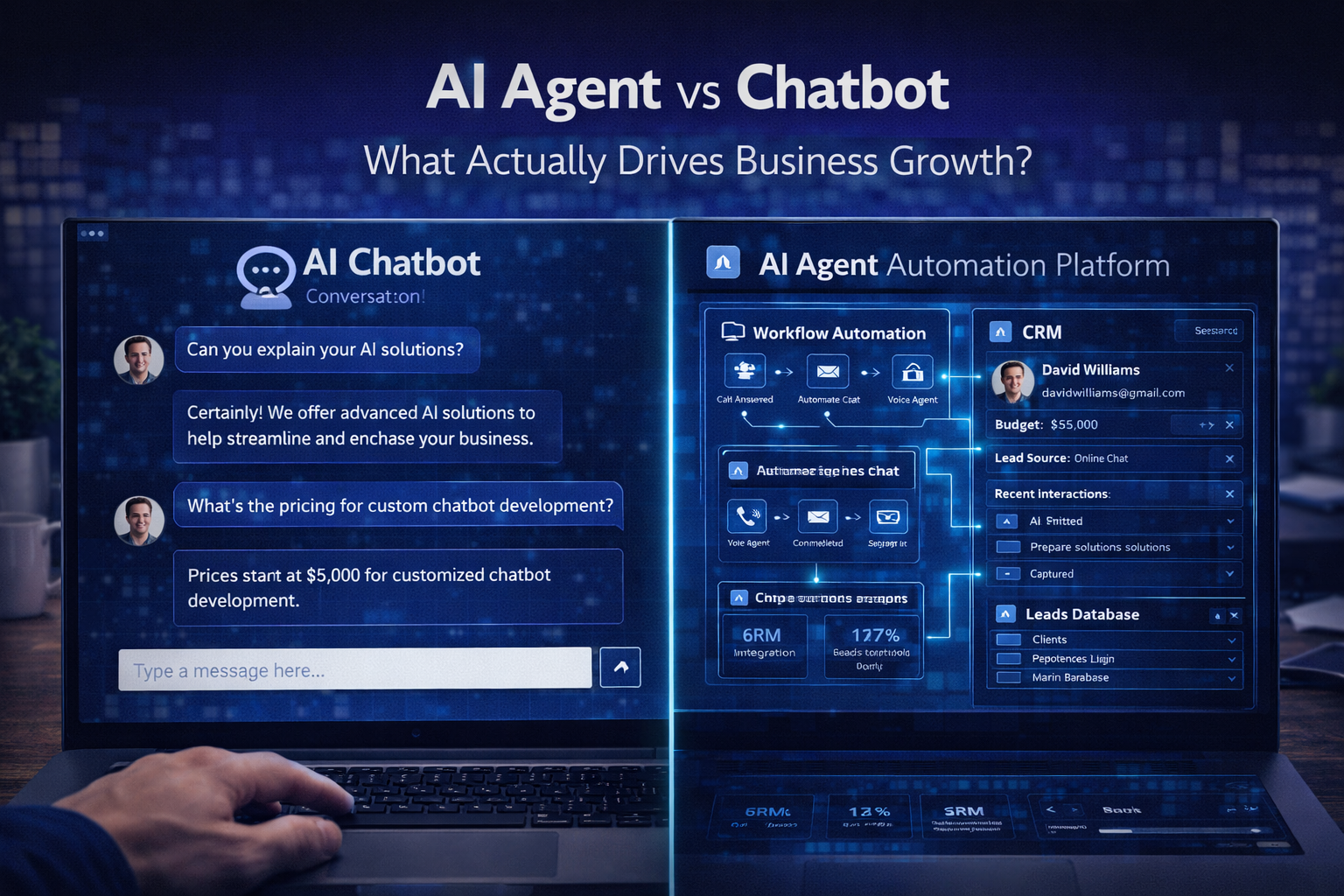
If you’ve been exploring AI for your business, you’ve probably come across two terms again and again: AI Agent vs Chatbot.
At first, they sound similar. Many people even use them interchangeably. But in reality, they are not the same thing, and understanding the difference can completely change how you approach automation in your business.
Let’s make this simple.
Imagine a customer visits your website and asks a question. A chatbot can answer that question instantly. It can explain your services, give basic information, and maybe collect their contact details.
Now imagine something more advanced.
The system doesn’t just answer the question. It understands what the customer wants, checks availability, qualifies the lead, books an appointment, updates your CRM, and sends a follow-up message automatically.
That is not just a chatbot anymore. That is an AI agent working behind the scenes.
This difference is where most businesses either win or lose.
Many companies think they have automation because they installed a chatbot. But in reality, they are only solving a small part of the problem. The real opportunity is not just answering questions. It is handling the entire workflow automatically.
In this guide, we will break everything down in a simple and clear way. You will understand what AI chatbots are, what AI agents are, how they are different, when to use each one, and how combining them can completely change your business operations.
What Is an AI Chatbot?
Let’s start with the simpler one.
An AI chatbot is a system that communicates with users through text or messaging. You usually see it as a small chat window on a website or inside platforms like Facebook Messenger.
The main purpose of a chatbot is to have conversations with users.
It can answer questions, provide information, and guide people through simple steps.
For example, a chatbot can:
- Answer questions about your services
- Explain pricing or packages
- Ask users what they are looking for
- Collect contact details
- Help users navigate your website
Modern chatbots are powered by artificial intelligence, which means they can understand natural language. Instead of clicking buttons or selecting options, users can type messages in their own words.
This makes the interaction feel more natural.
However, most chatbots are still limited in what they can do.
They are great at conversation, but not always great at taking action beyond the conversation.
They usually operate inside a single interface, and their role is focused on communication rather than execution.
What Is an AI Agent?
Now let’s talk about the more advanced system.
An AI agent is not just a conversational tool. It is a system that can think, decide, and take action across multiple tools and processes.
Instead of only responding to messages, an AI agent can:
- Trigger workflows
- Connect with different software systems
- Analyze information
- Perform multi-step tasks
- Make decisions based on conditions
For example, when a lead comes in, an AI agent can:
- Analyze the inquiry
- Determine if the lead is qualified
- Capture the customer’s information
- Schedule an appointment
- Update your CRM
- Send confirmation messages
- Start a follow-up sequence
All of this can happen automatically.
This is the key difference.
A chatbot talks.
An AI agent acts.
AI agents are usually built using a combination of:
- AI models (for understanding language)
- Automation workflows
- System integrations (CRM, scheduling, messaging tools)
This allows them to operate as part of a larger system rather than a single interface.
Why Businesses Get Confused Between AI Agent vs Chatbot
The confusion happens because both systems often start in the same place: a conversation.
From the outside, they can look similar.
A customer types a message. The system responds. It feels like the same thing.
But what happens after that response is where everything changes.
Many businesses install a chatbot and expect it to solve bigger problems like:
- missed leads
- slow follow-up
- poor conversion rates
- disorganized communication
But a chatbot alone usually cannot fix these issues.
Why?
Because these are not just communication problems. They are system problems.
This is where AI agents come in.
An AI agent does not stop at answering the question. It continues the process.
It moves the lead forward.
It completes the task.
It connects the systems.
That is why understanding this difference is so important before investing in automation.
Key Differences Between AI Agents and Chatbots
Let’s break this down in a very simple way.
- Purpose
A chatbot is designed for conversation.
An AI agent is designed for execution and automation.
- Scope
A chatbot usually works in one place, like a website chat window.
An AI agent works across multiple systems, including CRM, email, scheduling tools, and more.
- Capability
A chatbot answers questions.
An AI agent completes tasks.
- Complexity
Chatbots handle simple interactions.
AI agents handle multi-step workflows.
- Business Impact
Chatbots improve customer experience.
AI agents improve operations, efficiency, and revenue systems.
When Businesses Should Use AI Chatbots
Chatbots are still very useful. In fact, they are often the first step in automation.
You should use a chatbot when you want to:
- respond instantly to website visitors
- answer common questions
- reduce basic support workload
- collect simple lead information
- guide users through your services
For example, if someone visits your website and asks, “What services do you offer?”, a chatbot can answer that immediately.
This improves user experience and keeps visitors engaged.
Chatbots are especially useful for businesses that:
- receive many repetitive questions
- want to provide 24/7 communication
- need a simple entry point for automation
However, chatbots alone are not enough if your goal is to fully automate your business processes.
When Businesses Should Use AI Agents
AI agents become important when your goal is full automation, not just communication.
You should use AI agents when you want to:
- automate lead qualification
- schedule appointments automatically
- connect multiple tools together
- manage follow-up sequences
- reduce manual admin work
- build scalable systems
For example, instead of just collecting a lead’s name and email, an AI agent can:
- ask qualifying questions
- determine if the lead is serious
- book a meeting
- send reminders
- update your CRM
This removes multiple manual steps from your workflow.
AI agents are especially valuable for businesses that:
- handle a high volume of leads
- rely on fast response times
- want to scale without hiring more staff
- need structured systems for growth
AI Chatbots and AI Agents Working Together
This is where things become powerful.
The best systems do not choose between chatbots and AI agents. They combine both.
Think of it like this:
The chatbot is the front door.
The AI agent is everything happening behind the scenes.
Here is a simple example:
A customer visits your website and starts a chat.
The chatbot greets them and asks what they need.
The customer says they are looking for a service.
The chatbot asks a few questions and collects basic details.
Then the AI agent takes over.
It qualifies the lead, checks availability, books an appointment, updates your CRM, and sends confirmation messages.
From the customer’s perspective, everything feels simple and smooth.
From the business perspective, everything is automated.
This combination creates a complete system, not just a tool.
Real Business Example
Let’s make this real.
Imagine you run a landscaping business.
During peak season, your phone rings constantly. At the same time, people are visiting your website and sending inquiries.
You miss some calls because you are on a job site. You respond to others late because you are busy.
Now imagine a system built with AI Agents and Chatbots.
When someone visits your website, the chatbot responds instantly. It asks what service they need and collects details.
If someone calls, an AI voice agent answers the phone. It asks questions, gathers information, and books an estimate.
Behind the scenes, the AI agent:
- records all information in your CRM
- schedules appointments
- sends confirmations
- starts follow-up messages
You are still doing the work in the field.
But your system is handling communication.
This is where businesses start to see real results.
How FutureForge AI Solutions Builds These Systems
FutureForge AI Solutions focuses on building complete automation systems, not just standalone tools.
Instead of offering only chatbots, they combine:
- AI chatbots for website and messaging
- AI voice agents for phone calls
- workflow automation systems
- CRM integrations
This allows businesses to create a system where:
- no lead is missed
- responses are instant
- appointments are booked automatically
- follow-ups happen without manual effort
The goal is simple.
To build a system that works while the business owner is busy doing actual work.
This approach goes beyond basic automation and focuses on real operational improvement.
Common Mistakes Businesses Make
Many businesses make the same mistakes when adopting AI.
The first mistake is thinking a chatbot alone will solve everything.
It will help, but it will not fix deeper problems like missed follow-ups or poor lead management.
The second mistake is focusing only on tools instead of systems.
Buying software does not automatically create results. The system design is what matters.
The third mistake is ignoring integration.
If your chatbot is not connected to your CRM or scheduling system, you are still doing manual work.
The fourth mistake is not thinking about the full customer journey.
Automation should support the entire process, from first contact to final conversion.
Avoiding these mistakes can save time, money, and frustration.
The Future of AI Agents and Chatbots
The future is not about choosing one or the other.
It is about building systems where both work together seamlessly.
Chatbots will continue to improve in conversation quality. They will feel more natural and more helpful.
AI agents will become more powerful in handling complex tasks. They will connect more systems and automate more processes.
Businesses will move toward fully integrated automation systems where communication, data, and workflows are connected.
Those who adopt these systems early will have a major advantage.
Conclusion
The difference between an AI Agents and Chatbots is simple, but very important.
Chatbots handle conversations.
AI agents handle actions.
If your goal is only to answer questions faster, a chatbot is enough.
But if your goal is to automate your business, capture more leads, and build scalable systems, you need AI agents as well.
The most effective approach is to combine both into a single system.
That is where real automation happens.
And that is where businesses start to grow faster without increasing their workload.


