
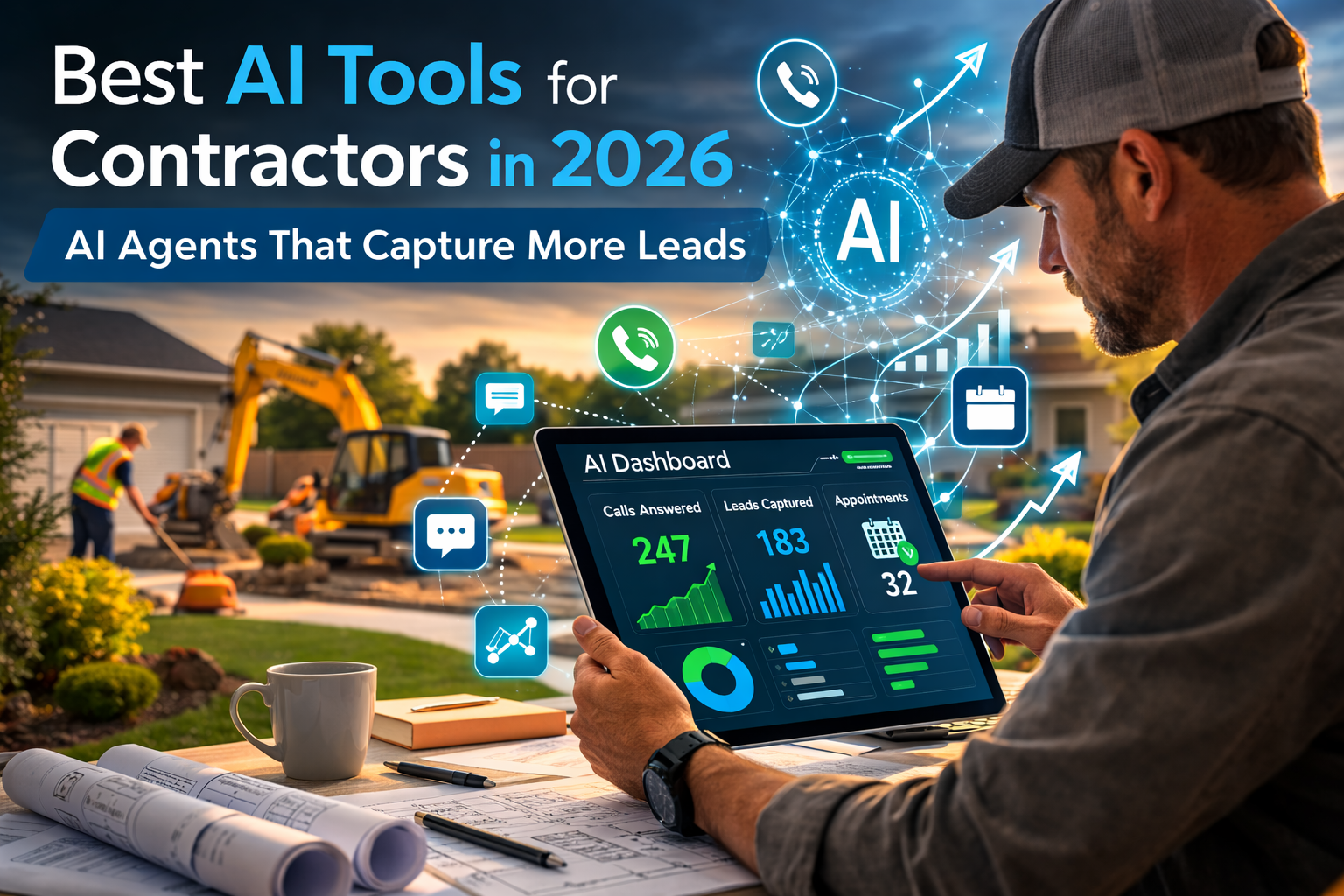
The construction and contracting industry has always relied on experience, skilled labor, and strong project management. But in recent years, something new has started to change how contractors run their businesses.
Artificial intelligence.
Many contractors once believed AI was only for large technology companies or complex software systems. Today that is no longer true. AI tools are now being used by small businesses, local contractors, and service companies to automate daily tasks, answer customer calls, manage projects, and improve communication.
In 2026, contractors who use AI tools are finding new ways to save time, capture more leads, and run more efficient businesses.
Instead of missing calls, chasing paperwork, and spending hours on administrative work, many companies are now using AI agents to handle those tasks automatically.
This guide explains some of the best AI tools and AI agents for contractors in 2026, how they work, and how they are helping contracting businesses grow.
Why Contractors Are Starting to Use AI
Contractors are some of the busiest business owners in the world.
Most of the work happens on job sites, not in offices. Contractors spend their days managing crews, operating equipment, visiting properties, and coordinating projects.
While all of this is happening, the business side of the company still needs attention.
Customer calls need to be answered. Estimates must be scheduled. Leads must be followed up with. Meetings need to be documented. Projects must be tracked.
For many contractors, this creates a constant struggle between doing the work and managing the business.
Artificial intelligence helps solve this problem by automating repetitive tasks.
Instead of doing everything manually, contractors can use AI systems to manage communication, organize data, and handle routine workflows.
The result is a business that runs more efficiently.
What Are AI Agents for Contractors?
An AI agent is a system that can perform tasks automatically using artificial intelligence.
Unlike traditional software tools that require manual input, AI agents can handle tasks independently.
For contractors, AI agents can help with many activities, including:
Answering incoming calls
Scheduling estimates
Responding to website inquiries
Organizing project data
Sending follow-up messages
Managing customer communication
These systems work continuously and do not require constant supervision.
In many cases, they act like a digital assistant that supports the business.
The Biggest Problem Contractors Face Today
One of the most common problems contractors face is missed opportunities.
Imagine a homeowner searching online for a contractor.
They find three companies and start calling.
The first company does not answer.
The second company sends the call to voicemail.
The third company answers and schedules an estimate.
Most customers will move forward with the company that responded first.
This means the job was not lost because the contractor was unqualified. It was lost because the call was missed.
This situation happens every day in industries such as:
Landscaping
HVAC services
Cleaning businesses
Plumbing companies
Home renovation services
AI tools can help prevent these missed opportunities.
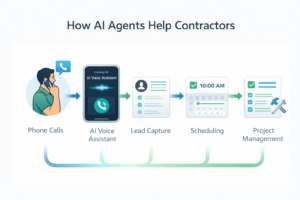
One of the most powerful AI tools contractors can use today is the AI voice agent.
An AI voice agent automatically answers incoming phone calls and speaks with customers naturally.
Instead of sending calls to voicemail, the system responds immediately and begins a conversation.
For example, when someone calls a contractor, the AI voice agent might say:
“Thanks for calling. How can I help you today?”
The system can then ask questions such as:
What service are you looking for?
What is your address?
When would you like the work completed?
After collecting the information, the AI agent can schedule an estimate or send the details to the contractor.
This allows contractors to capture leads even when they are busy working on job sites.
Platforms like GoHighLevel make it possible to build AI voice agents that integrate with customer relationship management systems.
Companies like FutureForge AI Solutions specialize in building customized AI voice systems that answer calls, qualify leads, and book appointments automatically.
For contractors, this can dramatically increase the number of opportunities captured.
Another powerful AI tool for contractors is the website chatbot.
Many customers visit contractor websites outside of business hours.
They may have questions about services, pricing, or scheduling.
Without a chatbot, the only option may be a contact form or an email.
With an AI chatbot, the website can start a conversation immediately.
For example, when someone visits the website, the chatbot may ask:
“How can we help you today?”
The chatbot can then collect information such as:
Customer name
Service needed
Location
Preferred appointment time
This information can be sent directly to the contractor’s CRM system.
The chatbot can also schedule consultations or estimates automatically.
This helps turn website visitors into real leads.
- AI Estimating Tools
Estimating projects is one of the most time-consuming tasks for contractors.
Creating accurate estimates requires reviewing plans, measuring materials, and calculating costs.
AI estimating tools are now helping contractors speed up this process.
These tools can analyze plans and project details to generate estimates more quickly.
Benefits include:
Faster bid preparation
Improved accuracy
Better project planning
Reduced manual calculations
Contractors who use AI estimating tools can often prepare proposals faster than competitors.
This allows them to respond to opportunities more quickly.
- AI Project Management Tools
Managing projects is another challenge contractors face.
Construction projects involve many moving parts.
Materials must arrive on time. Workers must follow schedules. Tasks must be completed in the correct order.
AI project management tools help organize this process.
These tools use artificial intelligence to monitor project progress and automate workflows.
Popular project management platforms include tools that track schedules, assign tasks, and generate progress reports.
AI features can help identify delays, monitor productivity, and improve project visibility.
This helps contractors stay organized and avoid costly mistakes.
- AI Jobsite Documentation Tools
Documentation is essential for many contracting businesses.
Contractors must record project progress, capture jobsite photos, and maintain records for clients.
AI documentation tools help automate these tasks.
For example, some tools automatically organize jobsite photos and connect them to specific projects.
This allows contractors to create reports quickly and share updates with clients.
Better documentation improves communication and helps protect businesses from disputes.
- AI Meeting and Communication Tools
Contractors often meet with clients, architects, engineers, and subcontractors.
Keeping track of meeting discussions can be difficult.
AI meeting tools can automatically record conversations and generate transcripts.
This makes it easier to review important details later.
These tools also help reduce misunderstandings because all participants can access accurate meeting records.
Workflow automation platforms help contractors automate repetitive tasks.
These systems connect different tools and automate processes.
For example, automation can handle tasks such as:
Sending appointment confirmations
Reminding clients about scheduled visits
Following up with leads
Updating customer records
Platforms like GoHighLevel allow contractors to build automation systems that manage communication and customer relationships in one place.
Automation reduces administrative work and ensures that no lead is forgotten.
- AI Marketing Tools for Contractors
Marketing is another area where AI tools can help contractors grow.
AI tools can assist with:
Creating social media content
Writing marketing emails
Designing promotional materials
Generating website content
Tools like AI writing assistants and design platforms allow contractors to create professional marketing content quickly.
This helps small businesses compete with larger companies.
- AI Lead Qualification Systems
Not every inquiry becomes a real project.
Some customers may simply be exploring options or requesting services outside the company’s scope.
AI lead qualification systems help filter these inquiries.
These systems ask questions to determine whether a lead is a good fit.
For example:
What type of service do you need?
What is your location?
What is your budget?
By collecting this information automatically, contractors can focus their time on the most promising opportunities.
Why AI Is Becoming Essential for Contractors
Several trends are driving the growth of AI tools in the contracting industry.
First, competition is increasing.
More contractors are entering local markets, which means businesses must respond faster and operate more efficiently.
Second, customer expectations are changing.
Customers expect quick responses, online scheduling, and professional communication.
Third, administrative work continues to grow.
Managing leads, projects, and documentation requires significant time and effort.
AI tools help contractors handle these challenges more efficiently.
How FutureForge AI Solutions Helps Contractors Use AI
FutureForge AI Solutions focuses on building AI automation systems for service businesses and contractors.
Instead of providing standalone tools, FutureForge creates integrated systems that combine multiple technologies.
These systems often include:
AI voice agents that answer calls instantly
AI chatbots that respond to website inquiries
Automated lead qualification systems
CRM platforms that organize customer data
Workflow automation that manages follow-ups
FutureForge builds many of these systems using GoHighLevel, which allows businesses to manage leads, communication, and automation in one platform.
The goal is to help contractors capture more opportunities while reducing administrative workload.
The Future of AI in the Contracting Industry
Artificial intelligence will continue to play a larger role in the contracting industry.
In the future, AI tools may help contractors with even more tasks.
These could include advanced project analytics, predictive scheduling, and automated cost forecasting.
As technology improves, AI systems will become even more helpful for managing complex projects.
Contractors who adopt these tools early may gain a significant competitive advantage.
Final Thoughts
The contracting industry is evolving quickly.
Artificial intelligence is no longer a technology reserved for large corporations.
Today, contractors of all sizes can use AI tools to improve efficiency, capture more leads, and manage their businesses more effectively.
From AI voice agents that answer customer calls to automation platforms that organize workflows, these technologies are helping contractors save time and grow faster.
Businesses that embrace AI today will likely be better prepared for the future.
Those that continue relying entirely on manual processes may find it harder to compete in an increasingly digital world.


