
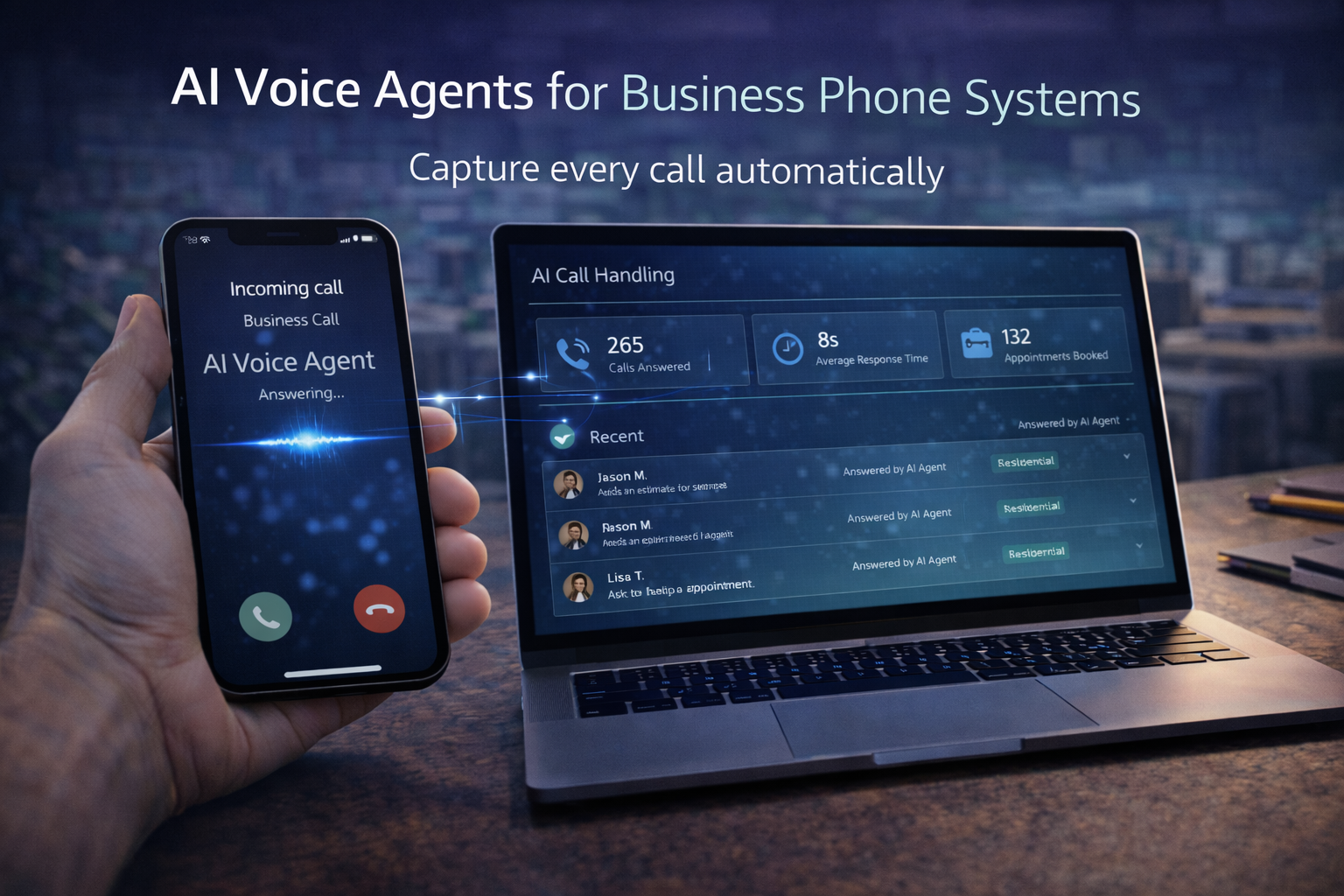
Best AI Voice Agent Solutions for Business Phone Systems
The Call That Most Businesses Never Notice
A homeowner needs a service.
Maybe their driveway needs repair. Maybe their lawn needs maintenance. Maybe they need a contractor to look at a project.
They search online and find several businesses nearby. They click on one website and decide to call.
The phone rings.
No one answers.
The call goes to voicemail.
The customer waits for a moment and hangs up.
Then they call the next business on the list.
That second company answers the phone immediately.
Within a few minutes, the conversation turns into an appointment.
The job is booked.
The first business never even realizes what happened.
They didn’t lose the job because their service was worse. They didn’t lose it because their price was higher.
They lost it because they didn’t answer the phone.
This situation happens thousands of times every day across the United States. Businesses invest money into marketing, advertising, and SEO to generate leads. But many of those leads disappear before a conversation even begins.
This is why companies are now searching for the best AI voice agent solutions for business phone systems.
AI voice agents are changing how businesses handle incoming calls. Instead of sending callers to voicemail, these systems answer calls instantly and begin a real conversation.
And in many industries, that simple change can mean the difference between losing a lead and booking a customer.
Why Traditional Business Phone Systems Are Falling Behind
For decades, business phone systems worked in a very simple way.
Someone called the business. A receptionist answered the phone. If no one was available, the call went to voicemail.
That model worked when most businesses operated with larger teams and when customers were more patient.
But communication has changed dramatically.
Today customers expect quick responses. If they cannot reach a business quickly, they assume the company is busy or unavailable.
Instead of waiting, they simply move on.
Traditional phone systems were designed to route calls. They were not designed to handle conversations automatically.
Most systems today still rely on voicemail, call forwarding, or simple phone menus.
You have probably heard these menus before:
Press one for sales.
Press two for support.
Press three for billing.
While these systems organize calls, they do not actually help the customer solve their problem.
That is where AI voice agents come in.
Instead of sending callers through menus, AI voice agents can speak with them directly.
What AI Voice Agents Actually Do
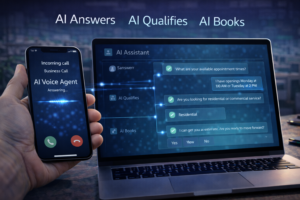
An AI voice agent is a conversational system that can answer business phone calls and interact with customers.
Instead of playing recorded messages, the system actually listens and responds to the caller.
Modern AI voice agents can:
Answer incoming calls instantly
Greet customers naturally
Understand questions and requests
Ask follow-up questions
Collect customer information
Schedule appointments
Transfer calls when necessary
The experience feels much closer to speaking with a real receptionist.
The caller explains what they need, and the system guides them through the next steps.
For example, imagine a customer calling a landscaping company.
The AI voice agent might say:
“Thank you for calling. How can I help you today?”
The caller might respond:
“I’m looking for someone to give me a quote for lawn maintenance.”
The AI system can then ask questions such as:
“What is the address of the property?”
“When would you like the estimate?”
“What type of service are you looking for?”
By the time the conversation finishes, the system has already collected the information needed to schedule a visit.
Instead of losing the call, the business has captured a qualified lead.
The Technology Behind AI Voice Agents
While AI voice agents feel simple to use, several technologies work together behind the scenes.
These technologies allow the system to understand and respond to callers naturally.
Speech Recognition
Speech recognition technology allows the system to understand spoken language.
When a caller speaks, the system converts their voice into text.
Modern speech recognition systems are very accurate, even when people speak quickly or with different accents.
Natural Language Processing
Natural language processing helps the system understand the meaning behind the caller’s words.
For example, if someone says:
“I need someone to fix my driveway.”
The AI understands that the caller is requesting a service related to driveway repair.
This allows the system to respond appropriately.
AI Voice Generation
Once the AI determines the response, voice synthesis technology converts the text into spoken language.
Older systems sounded robotic, but modern AI voices sound much more natural.
Many callers cannot even tell they are speaking with an AI system.
Automation Workflows
The final piece connects the conversation to business processes.
For example, when a caller requests an appointment, the system can check calendar availability and schedule the booking automatically.
These workflows allow AI voice agents to handle many tasks that once required manual work.
What Makes the Best AI Voice Agent Solutions for Business Phone Systems
Not all AI voice agents are created equal.
Some systems are basic and limited, while others provide advanced conversational capabilities.
Businesses looking for the best AI voice agent solutions for business phone systems should focus on several important factors.
Natural Voice Quality
The voice must sound clear, friendly, and professional.
Customers should feel comfortable speaking with the system.
If the voice sounds too robotic, callers may hang up.
Instant Call Response
The system should answer calls immediately.
Even a delay of a few seconds can cause frustration.
Conversation Intelligence
The AI should understand customer requests and guide conversations smoothly.
Lead Qualification
The system should ask questions that help identify serious opportunities.
Appointment Scheduling
The AI should be able to schedule meetings or service visits automatically.
Integration With Business Tools
The system should connect with calendars, CRM platforms, and messaging tools.
When these features work together, AI voice agents become extremely powerful tools for businesses.
Industries That Benefit Most From AI Voice Agents
Many industries rely heavily on phone calls to capture new business.
AI voice agents can dramatically improve communication in these sectors.
Home Service Businesses
Contractors, plumbers, landscapers, and electricians often miss calls while working in the field.
AI voice agents ensure those calls are answered.
Medical Offices
Healthcare providers receive large volumes of calls related to appointments and patient questions.
AI systems help manage this demand.
Real Estate
Real estate agents often receive inquiries outside of business hours.
AI voice agents allow potential buyers to get information quickly.
Local Service Businesses
Many small businesses rely heavily on phone inquiries.
AI voice agents help capture leads that might otherwise disappear.
Real Business Benefits of AI Voice Agents
Businesses that implement AI voice agents often notice significant improvements.
Fewer Missed Calls
Every call receives attention instead of going to voicemail.
Faster Lead Response
Customers receive immediate answers.
Better Lead Qualification
Businesses can identify serious opportunities quickly.
Improved Customer Experience
Callers appreciate quick and helpful responses.
Higher Conversion Rates
More conversations turn into booked appointments.
These benefits help businesses grow without increasing staffing costs.
How FutureForge AI Solutions Helps Businesses Implement AI Voice Agents
While AI voice technology is powerful, implementing it effectively requires the right system design.
This is where FutureForge AI Solutions plays an important role.
FutureForge focuses on building intelligent automation systems that help businesses capture and manage customer communication.
Instead of simply providing software, FutureForge designs AI voice agent systems that integrate directly into business workflows.
These systems can:
Answer incoming calls instantly
Speak naturally with callers
Qualify leads automatically
Capture customer information
Schedule appointments
Trigger follow-up automation
The goal is not to replace human employees.
The goal is to ensure that every customer inquiry receives a response.
FutureForge systems help businesses eliminate the communication gaps where many opportunities are lost.
How Businesses Can Start Using AI Voice Agents
Adopting AI voice technology does not require completely changing how a business operates.
Most companies begin by identifying where communication delays occur.
In many cases, missed calls are the biggest problem.
Once that issue is identified, businesses can introduce AI voice agents to answer incoming calls.
After the system is running, companies often expand automation to other communication channels.
For example:
AI chat systems for website visitors
SMS automation for customer messages
Follow-up workflows for new leads
Over time, these systems create a communication infrastructure that keeps conversations moving.
The Future of AI Voice Agents
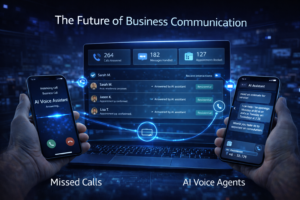
AI voice technology is evolving rapidly.
Future systems will likely become even more advanced.
Voices will continue sounding more natural.
AI systems will better understand conversation context.
Voice agents may even detect emotional tone and adjust responses accordingly.
Businesses that adopt these technologies early will be better prepared for the future of customer communication.
Final Thoughts
Customer communication is changing.
Today, speed matters more than ever.
Many businesses invest heavily in marketing to generate leads, but they lose opportunities simply because they cannot respond quickly enough.
AI voice agents solve this problem by ensuring every call receives attention.
Instead of relying on voicemail, businesses can create systems that answer calls, qualify leads, and schedule appointments automatically.
Choosing the best AI voice agent solutions for business phone systems allows companies to capture more opportunities and improve customer experience.
For many businesses, the biggest improvement does not come from generating more leads.
It comes from answering the phone at the right moment.


