
Customer expectations have changed faster than most businesses realize.
Ten years ago, customers were willing to wait. They would leave a voicemail, send an email, or call again later if a company did not respond immediately.
Today that patience is gone.
When someone calls a business, they expect an answer right away. If they cannot reach someone within a few seconds, they often move on to the next company.
This shift in behavior is one of the biggest reasons businesses are now searching for the best AI voice assistants for customer support automation.
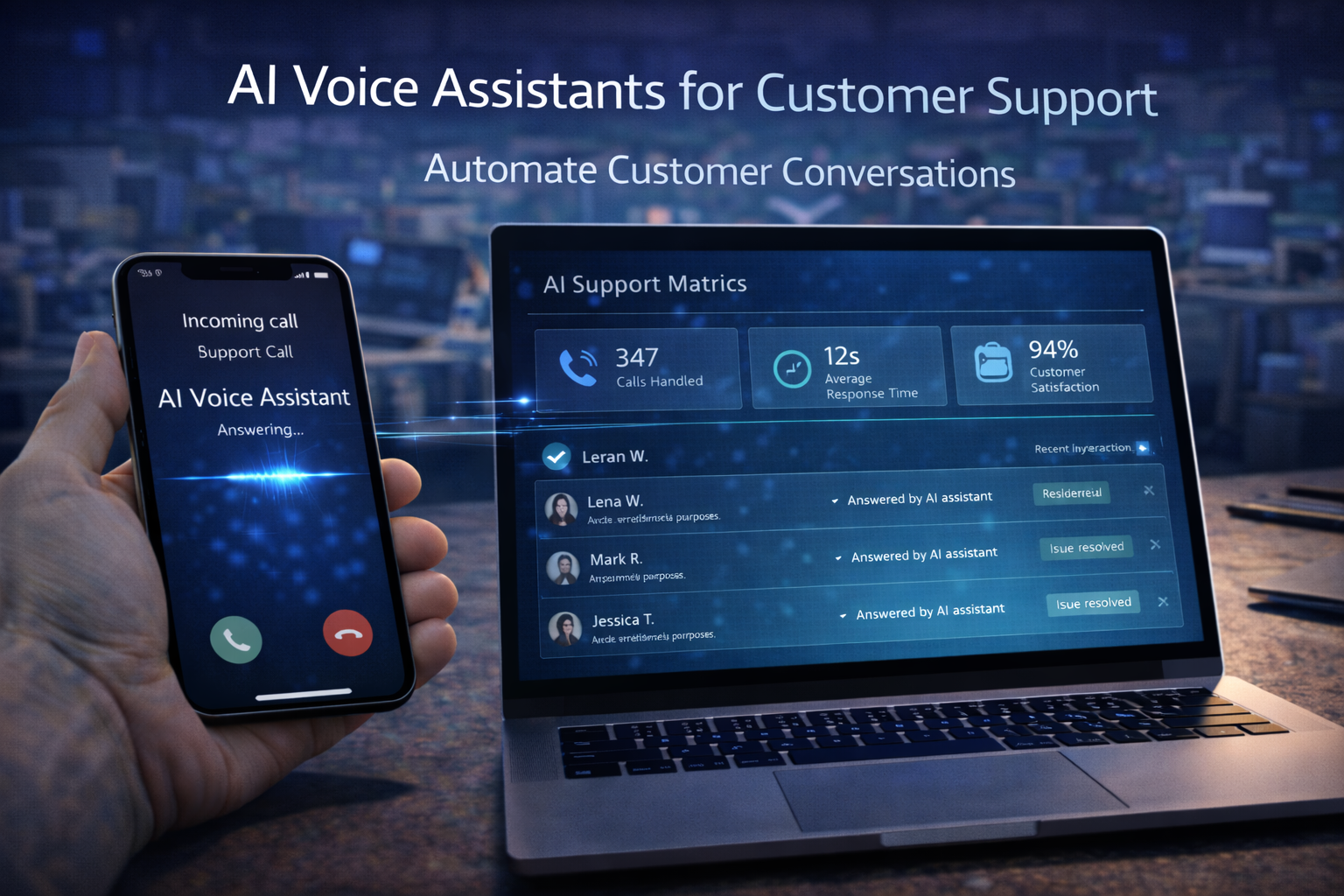
AI voice assistants allow companies to answer calls instantly, speak naturally with customers, collect information, and solve common problems without requiring a human agent every time.
Instead of letting calls go to voicemail, businesses can now build systems that respond immediately and keep conversations moving.
For many companies, this technology is quickly becoming one of the most important parts of modern customer support.
In this guide, we will explore how AI voice assistants work, why businesses are adopting them, which platforms are leading the market, and how companies can use these systems to improve customer experience and increase revenue.
Why Customer Support Is Changing

Customer communication used to be slower and more predictable.
Businesses had office hours, and customers usually called during those hours. If someone called after closing time, they expected to wait until the next day.
But modern communication habits are very different.
Customers now expect instant responses. They are used to real-time messaging, fast online services, and immediate answers.
This means customer support systems must be faster and more responsive than ever before.
Unfortunately, many businesses still rely on traditional phone systems that cannot keep up with these expectations.
A typical support call often follows this pattern.
A customer calls a business.
The phone rings several times.
If no one answers, the call goes to voicemail.
The customer may leave a message, but many do not.
Instead, they hang up and try another company.
The original business may never even know that call happened.
This is one of the hidden problems in customer support.
Companies invest heavily in marketing and advertising to generate leads, but those opportunities disappear simply because no one answered the phone.
This is where AI voice assistants provide a major advantage.
What Is an AI Voice Assistant
An AI voice assistant is an automated system that can speak with customers over the phone.
Instead of playing a recorded message or forcing callers through complicated phone menus, the system listens to what the caller says and responds naturally.
These assistants use artificial intelligence to understand questions, provide answers, and guide conversations.
For example, if a customer calls a company and says:
“I need help scheduling a service appointment.”
The AI voice assistant can respond with something like:
“Of course. I can help with that. What day would you like to schedule the appointment?”
The conversation continues just like a normal phone call.
The system can ask questions, collect information, and even schedule appointments.
By the end of the conversation, the customer may already have a confirmed booking.
The business did not need to manually answer the call, but the customer still received immediate help.
How AI Voice Assistants Work
AI voice assistants combine several technologies that work together to handle conversations.
Understanding these technologies helps explain why modern systems are so effective.
Speech Recognition
Speech recognition technology converts spoken words into text.
When a customer speaks into the phone, the AI system listens and translates the audio into written language that the system can understand.
Modern speech recognition systems are extremely accurate and can understand different accents and speaking styles.
Natural Language Processing
Natural language processing helps the AI understand the meaning behind the words.
For example, if a caller says:
“I need someone to come look at my driveway.”
The AI system understands that the caller is requesting a service estimate.
It then decides how to continue the conversation.
AI Decision Logic
Once the system understands the request, it determines the appropriate response.
This may involve asking additional questions, providing information, or scheduling a service appointment.
Voice Generation
The system then converts the response into spoken language using AI voice technology.
Modern AI voices sound very natural and are much more pleasant than older automated phone systems.
This makes the conversation feel comfortable for customers.
Why Businesses Are Adopting AI Voice Assistants
Companies across many industries are adopting AI voice assistants because they solve several common customer support challenges.
Instant Call Response
AI voice assistants answer calls immediately.
Customers do not need to wait for someone to become available.
24 Hour Availability
AI systems can operate all day and all night.
Customers can call at any time and still receive assistance.
Reduced Support Costs
Businesses often spend large amounts of money on customer support staff.
AI voice assistants can handle many routine conversations automatically, allowing human teams to focus on more complex tasks.
Consistent Customer Experience
Human agents may provide different responses depending on their experience or mood.
AI systems follow consistent processes, ensuring that every customer receives the same quality of support.
Increased Lead Capture
Perhaps the biggest benefit is preventing missed opportunities.
When every call is answered, businesses capture leads that might otherwise disappear.
Best AI Voice Assistants for Customer Support Automation
Several platforms are leading the development of AI voice assistants.
Each platform offers different features and capabilities depending on the needs of the business.
PolyAI
PolyAI is one of the most advanced voice AI platforms designed specifically for large call centers.
The company focuses heavily on creating conversations that feel natural and human.
PolyAI systems are often used by airlines, banks, and large service organizations that handle thousands of calls per day.
The platform can handle complex conversations and manage large volumes of customer inquiries.
Cognigy AI
Cognigy AI is a powerful conversational AI platform that supports both voice and chat automation.
Businesses use Cognigy to build intelligent support systems that can answer questions, guide customers through processes, and automate routine tasks.
The platform integrates with many CRM and customer service tools, making it a strong choice for enterprise environments.
Retell AI
Retell AI is a newer platform designed specifically for real-time voice conversations.
The system focuses on fast response times and smooth call interactions.
Many companies use Retell AI to create voice assistants that answer inbound calls and qualify leads automatically.
Amazon Lex
Amazon Lex is part of the Amazon Web Services ecosystem.
It powers the technology behind Alexa and allows developers to build conversational voice assistants for businesses.
Because it integrates with many AWS tools, it is often used by companies that already rely on Amazon’s cloud services.
Synthflow AI
Synthflow AI focuses on building highly customizable voice agents.
Businesses can create AI voice assistants that match their specific workflows and communication style.
The platform is particularly popular for companies that want to automate phone conversations without complex development.
How Businesses Use AI Voice Assistants in Customer Support
AI voice assistants can handle many types of customer interactions.
Here are some common examples.
Call Answering
The system answers incoming calls immediately and greets the caller.
Customer Questions
Many customers call with simple questions about services, pricing, or availability.
AI voice assistants can provide these answers automatically.
Appointment Scheduling
Customers can book appointments directly through the AI system.
The assistant collects the necessary details and confirms the booking.
Lead Qualification
Businesses often need to gather information from new customers before providing a quote.
AI voice assistants can ask the right questions and capture important details.
Call Routing
If a conversation becomes more complex, the AI system can transfer the call to a human representative.
The Future of Customer Support Automation
AI voice technology is evolving rapidly.
As the technology improves, voice assistants will become even more capable.
Future systems will likely include features such as:
More human-like conversations
Better understanding of context
Emotion detection in voice tone
Personalized responses based on customer history
These advancements will allow AI systems to handle even more complex customer interactions.
Businesses that adopt these technologies early will have a significant advantage.
How FutureForge AI Solutions Helps Businesses Implement AI Voice Assistants
Implementing AI voice assistants is not just about choosing the right software.
The system must also be designed carefully to match the business workflow.
This is where FutureForge AI Solutions provides value.
FutureForge specializes in building AI automation systems that help businesses manage customer communication more effectively.
Instead of simply installing a tool, FutureForge designs intelligent workflows that connect voice assistants with the company’s sales and support processes.
For example, a FutureForge AI voice system can:
Answer incoming customer calls
Speak naturally with callers
Collect customer information
Qualify leads automatically
Schedule appointments instantly
Trigger follow-up messages
The goal is to ensure that every customer inquiry receives a response.
This helps businesses capture more opportunities and improve customer satisfaction.
Choosing the Right AI Voice Assistant for Your Business
Selecting the best AI voice assistant depends on several factors.
Businesses should consider the following questions.
How many calls does your company receive each day?
Do customers often call outside of business hours?
What types of questions do customers usually ask?
Do you need the system to schedule appointments or qualify leads?
The answers to these questions help determine which platform and automation strategy will work best.
In many cases, businesses start with simple call answering and lead capture.
Over time, they expand automation to include more advanced features.
Final Thoughts
Customer communication is changing quickly.
Businesses that rely only on traditional phone systems are increasingly struggling to keep up with customer expectations.
AI voice assistants provide a powerful solution.
They allow businesses to answer calls instantly, guide conversations naturally, and capture leads automatically.
For companies that receive a large number of phone inquiries, these systems can dramatically improve customer support efficiency.
More importantly, they help ensure that opportunities are not lost simply because no one answered the phone.
As AI technology continues to evolve, voice assistants will likely become a standard part of customer support for businesses around the world.
Companies that adopt these systems early will be better positioned to deliver faster service, improve customer experience, and grow more efficiently.


