
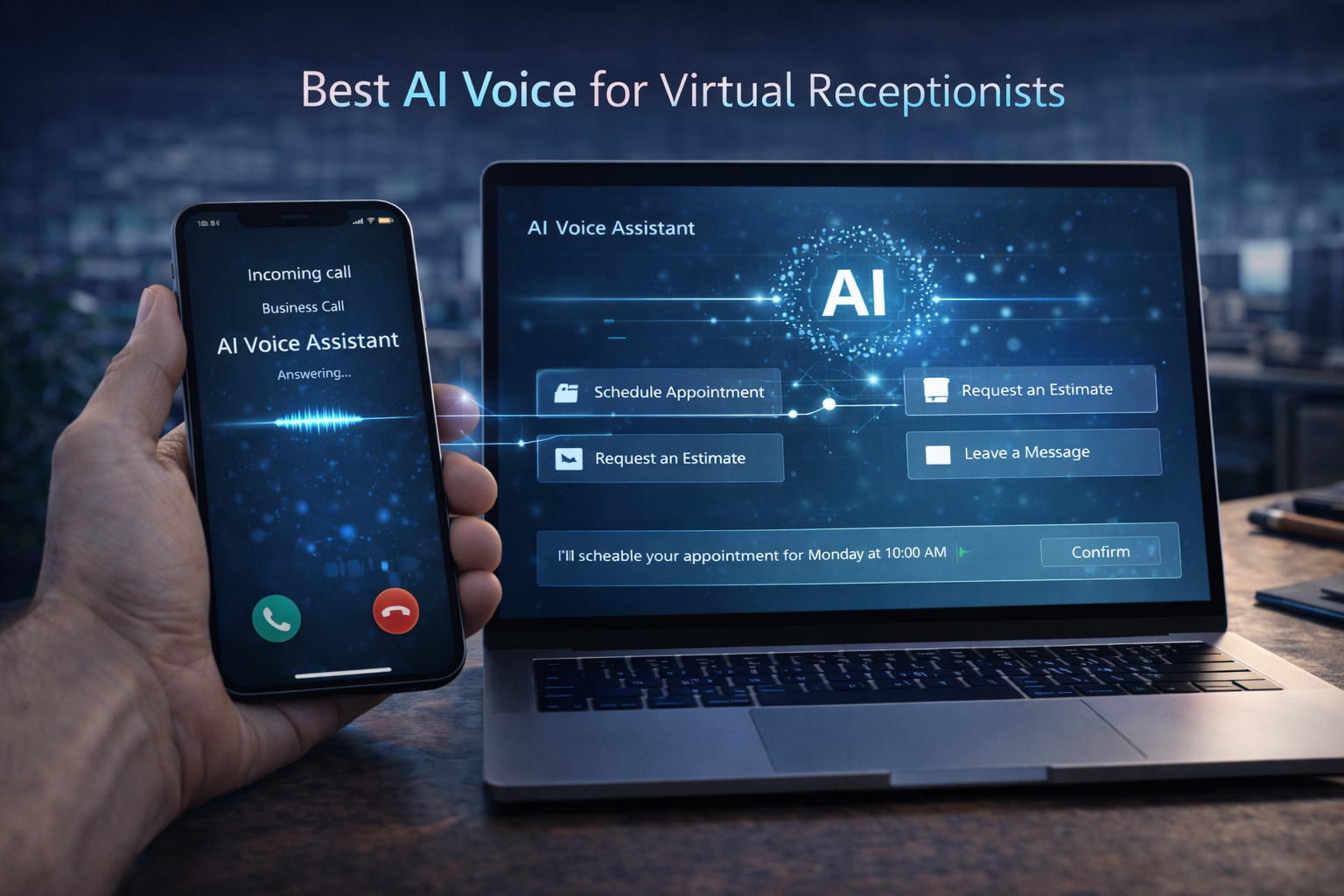
Best AI Voice for Virtual Receptionists in 2026 (Complete Guide)
Businesses today receive many customer calls every day. Some calls come from people who want to ask questions. Some want a price estimate. Others are ready to book a service immediately.
But here is the problem.
Many businesses cannot answer every call.
The phone rings while the owner is working. The team is busy helping customers. Sometimes the call comes after business hours. Sometimes the line is already busy.
When that happens, the call is missed.
And most of the time, the customer does not leave a voicemail. They simply call another company.
This is how many businesses lose opportunities without even realizing it.
In recent years, companies have started solving this problem using AI virtual receptionists. These systems can answer calls automatically, talk with customers, and collect important information.
But there is one detail that matters more than most people think.
The voice.
If the AI voice sounds robotic or unnatural, customers quickly lose trust. But if the voice sounds natural and friendly, the experience feels almost like talking to a real receptionist.
This is why many companies today are searching for the best AI voice for virtual receptionists. The right voice technology can completely change how customers experience your business.
In this guide, we will explore how AI voice receptionists work, which technologies power them, and why choosing the right AI voice can improve customer communication and lead conversion.
A Small Moment That Decides a Customer
Imagine this situation.
A homeowner needs landscaping work. They search online and find several companies near them. They choose one and make a call.
The phone rings.
No answer.
They wait for a moment and then hang up.
Then they call the next company on the list.
The second company answers immediately.
Who do you think gets the job?
In many cases, the fastest response wins.
The quality of the work might be better at the first company. The price might be lower. The service might be better.
But none of that matters if the conversation never begins.
This is why many businesses are starting to focus not only on marketing but also on how quickly they respond to customers.
AI virtual receptionists help solve this problem by ensuring someone answers the phone every time.
But for this system to work well, the voice must sound natural and professional.
That is why businesses are looking for the best AI voice for virtual receptionists.
What an AI Virtual Receptionist Actually Does
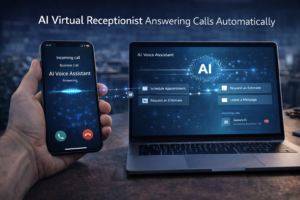
Some people think an AI receptionist simply plays recorded messages.
Modern systems are very different.
Today’s AI receptionists can actually hold conversations with callers.
A typical AI virtual receptionist can:
Answer incoming calls instantly
Greet the customer politely
Ask questions about the service they need
Collect important details such as name and address
Book appointments or estimates
Send confirmation messages
Instead of sending the caller to voicemail, the AI system begins a conversation.
The goal is simple.
Do not let the opportunity disappear.
Even when employees are busy or unavailable, the AI system keeps the conversation moving.
Why Voice Quality Matters More Than You Think
Customers notice voice quality immediately.
If the voice sounds robotic or strange, people feel uncomfortable. Many callers will simply hang up.
This happens because humans are very sensitive to how voices sound. Tone, rhythm, and emotion all affect how we interpret a conversation.
If a voice sounds natural, we feel comfortable continuing the conversation.
If it sounds artificial, we lose trust quickly.
Early automated phone systems sounded very mechanical. They spoke slowly and could not respond naturally.
But modern AI voice technology has improved dramatically.
Today, the best AI voice for virtual receptionists can sound very close to a real human voice.
These systems use advanced speech models that mimic natural conversation patterns. The result is a voice that sounds friendly, clear, and professional.
When callers hear this type of voice, they are more likely to stay on the line and continue the conversation.
How AI Voice Technology Works
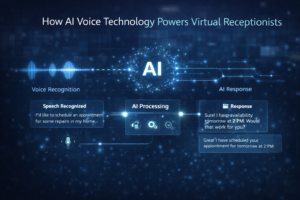
Behind every AI voice receptionist are several technologies working together.
Even though the system feels simple to the caller, there is complex technology operating in the background.
Understanding these components helps explain why modern systems sound so natural.
Speech Recognition
The first step is understanding the caller.
Speech recognition technology listens to the caller and converts their spoken words into text.
For example, if a caller says:
“I need a quote for lawn maintenance.”
The system converts that sentence into text that the AI can understand.
Language Understanding
After the system recognizes the words, it must understand what the caller wants.
This is where natural language processing comes in.
The AI analyzes the sentence and identifies the caller’s intent.
In this case, the intent may be:
Requesting a service estimate.
Once the AI understands the intent, it decides how to respond.
AI Voice Generation
The final step is responding to the caller.
The system generates a response and converts the text back into speech using advanced voice technology.
This is where voice quality becomes important.
The best AI voice for virtual receptionists uses neural speech models that create smooth, natural sounding sentences instead of robotic audio.
Features That Make the Best AI Voice for Virtual Receptionists
Not all AI voices are the same.
Some systems sound realistic, while others still feel mechanical.
Businesses looking for the best AI voice should pay attention to several important features.
Natural Tone
The voice should sound friendly and conversational.
Customers should feel comfortable speaking with it.
Fast Response Speed
A good system responds instantly.
Delays make conversations feel unnatural.
Clear Pronunciation
The voice should pronounce words clearly and naturally.
Mispronunciations reduce trust.
Conversation Flow
The system should handle conversations smoothly.
The caller should feel guided through the process.
Context Awareness
The AI should understand the conversation context and respond appropriately.
These features together create a professional caller experience.
Best AI Voice Technologies for Virtual Receptionists
Several companies are leading the development of AI voice technology today.
These tools power many AI reception systems used by businesses.
ElevenLabs
ElevenLabs is known for producing extremely realistic voices.
Its speech technology focuses on natural tone and emotion, making it ideal for conversational AI systems.
Many developers consider it one of the most human-like AI voice technologies available today.
Google WaveNet
Google’s WaveNet voice technology is widely used in enterprise applications.
It produces very smooth and natural speech patterns.
Because of its reliability and scalability, many large platforms rely on this technology for voice systems.
Amazon Polly
Amazon Polly is another popular speech engine used by developers.
It supports multiple voice styles and languages and is known for its stability.
Many business applications use Amazon Polly to power automated call systems.
PlayHT
PlayHT offers a wide range of voice options and languages.
It is often used for applications that require flexible voice customization.
These technologies help developers build advanced AI voice systems capable of handling real customer conversations.
Industries That Benefit Most from AI Voice Receptionists
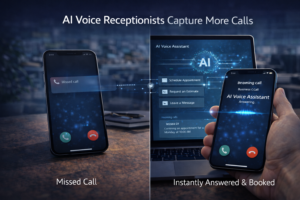
Many industries are adopting AI receptionists because they struggle with missed calls.
Some businesses benefit more than others.
Home Service Businesses
Contractors, landscapers, and plumbers often work on-site.
They cannot always answer the phone while working.
AI receptionists ensure calls are handled immediately.
Medical Clinics
Medical offices receive many calls every day.
AI receptionists can help schedule appointments and collect information before transferring calls.
Real Estate Agencies
Many real estate inquiries happen outside office hours.
AI receptionists can respond instantly and capture lead information.
Local Service Businesses
Local companies often lose customers due to missed calls.
AI reception systems help capture those opportunities.
The Business Benefits of AI Voice Receptionists
Businesses that adopt AI voice receptionists often see several important improvements.
24 Hour Call Coverage
Customers can reach the business anytime, even after hours.
Faster Lead Response
Calls are answered instantly instead of going to voicemail.
Fewer Missed Opportunities
The system ensures that every caller receives attention.
Better Customer Experience
Customers appreciate quick responses and helpful conversations.
These benefits help businesses convert more inquiries into paying customers.
AI Voice Receptionists vs Traditional Receptionists
Human receptionists provide valuable personal interaction, but they also have limitations.
They can only handle a limited number of calls at once and work during specific hours.
AI receptionists operate differently.
They can answer multiple calls simultaneously and operate around the clock.
Many businesses combine both approaches.
AI handles initial calls and simple tasks, while human staff manage complex situations.
This hybrid approach often creates the best customer experience.
How to Choose the Best AI Voice for Virtual Receptionists
If a business is considering AI voice technology, choosing the right system is important.
Here are a few key steps to follow.
Test the voice quality carefully. The voice should sound natural and pleasant.
Check how well the system understands callers. Speech recognition accuracy matters.
Make sure the system can collect customer information easily.
Look for systems that support appointment scheduling and lead capture.
Finally, ensure the system integrates smoothly with the business workflow.
Choosing the best AI voice for virtual receptionists is not only about technology. It is about creating a positive experience for customers.
The Future of AI Voice Receptionists
AI voice technology is improving rapidly.
Future systems will likely include even more advanced features.
These may include emotional tone detection, allowing the AI to recognize when a caller sounds frustrated or urgent.
Voice systems will also become more personalized, adapting responses based on previous customer interactions.
As these technologies evolve, AI receptionists will become an even more powerful tool for businesses.
Final Thoughts
Many businesses focus heavily on generating leads.
But capturing those leads is equally important.
Missed calls and slow responses quietly reduce revenue every day.
AI virtual receptionists help solve this problem by answering calls instantly and guiding customers through the next steps.
However, the success of these systems depends heavily on voice quality.
The best AI voice for virtual receptionists creates natural conversations that build trust with callers.
When businesses combine fast response systems with natural voice technology, they can turn more inquiries into real customers.
Sometimes growth does not come from more marketing.
Sometimes it comes from simply answering the phone at the right moment.


