
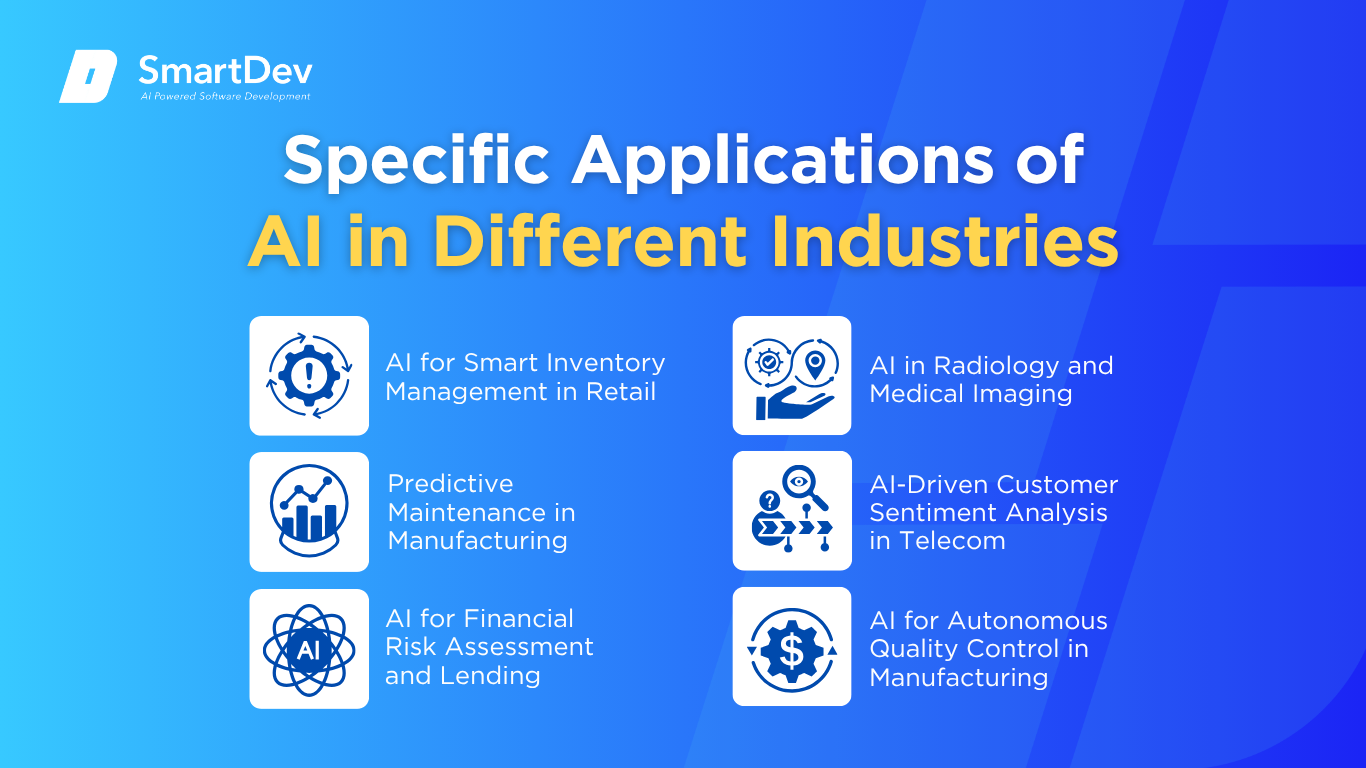
How AI Is Transforming Industries: Sector Uses, Metrics, What’s Next
Estimated reading time: 12 minutes
Key takeaways
- AI industry disruption reshapes processes, business models, and jobs via automation, predictive analytics, personalization, and agentic systems.
- Sector-specific AI applications (healthcare, finance, manufacturing, retail, transportation, agriculture) deliver measurable gains but require governance, data quality, and reskilling.
- Start with focused pilots (90 days), build data/MLOps foundations, and implement model governance to manage risks like bias, hallucinations, and regulatory compliance.
Table of contents
- How AI Is Transforming Industries: Sector Uses, Metrics, What’s Next
- Introduction: how AI is transforming industries, the big picture
- Goal of this article
- Section A — AI industry disruption: what it is and how change happens
- How AI Is Transforming Industries — Sector Snapshot
- Section C — Examples of transformation (case boxes)
- Section D — What businesses gain and may lose
- Section E — Future trends and implications
- Quick checklist — 3‑step AI readiness
- FAQ
- Conclusion & CTAs
- Visuals & data assets suggestions
- Acknowledgments and sources
Introduction: how AI is transforming industries, the big picture
Understanding how AI is transforming industries is essential for business leaders who must balance automation opportunities with risks, regulation, and workforce change. In this post, AI refers to the set of technologies — machine learning, deep learning, generative AI, computer vision, natural language processing, and agentic systems — that enable systems to perform tasks that historically required human intelligence. For context on job impacts and small business concerns see Is AI replacing jobs? (FutureForge).
Goal of this article
- Give you a clear, sector-by-sector view of AI industry disruption.
- Show sector-specific AI applications with real examples and measurable outcomes.
- Flag risks, adoption barriers, and trends you should track next.
Two facts that set the stage
- AI is reshaping the global economy through rapid advances in machine learning, generative AI and automation, driving efficiency, personalization, and new business models across sectors.
- Research maps sectors negatively impacted and disrupted by AI — from manufacturing to retail — with concrete risk signals; see the DigitalDefynd report.
Section A — AI industry disruption: what it is and how change happens
Definition:
AI industry disruption is the process by which AI technologies fundamentally reconfigure business processes, market structures, and job roles by automating tasks, improving decision-making with data-driven models, enabling new products/services, and creating efficiency or scale advantages that incumbents may struggle to match.
Four primary mechanisms of change
-
- Automation of repetitive tasks
What happens: Robotic process automation (RPA) speeds up back-office work. On the factory floor, computer vision plus robotics automate pick, place, and inspect. See 10 repetitive tasks to automate with AI (FutureForge).
Evidence: Industrial robots now handle approximately 44% of manufacturing repetitive tasks (DigitalDefynd). Source.
- Automation of repetitive tasks
-
- Predictive analytics and decision augmentation
What happens: Predictive models (time-series forecasting, anomaly detection) cut downtime with predictive maintenance and improve inventory forecasting.
Evidence: Cross-industry analysis shows AI boosts operational decisions and planning through predictive analytics. Coveo overview.
- Predictive analytics and decision augmentation
-
- Personalization and customer experience
What happens: NLP and recommendation systems tailor offers in real time using collaborative filtering and transformer-based ranking.
Evidence: AI personalization and in-product support increase engagement and relevance. Coveo.
- Personalization and customer experience
- New business models and agentic systems
What happens: Generative AI with retrieval-augmented generation (RAG) grounds answers in enterprise knowledge. Agentic AI can trigger actions and run autonomous workflows, enabling embedded-AI products and platform advantages.
Evidence: Analysts highlight potential disruption to SaaS economics and big tech moats (see the Bain Technology Report 2025 and Coveo).
Challenges leaders must manage
- Job displacement and task shift: An estimated 1.7 million manufacturing jobs have shifted globally; up to 52% of retail in-store tasks are automatable. DigitalDefynd.
- Hallucinations and accuracy risks: Around 49% of users report GenAI hallucination issues; grounded approaches like RAG aim to reduce this. Coveo.
- Regulation and ethics: Bias, privacy, model governance, and evolving rules will shape adoption speed and cost. Bain.
- Workforce and education: Education systems must adapt so workers can reskill for AI-augmented roles. WEF.
How AI Is Transforming Industries — Sector snapshot
Healthcare — sector-specific AI applications for diagnosis and care
Core challenge: Faster, more accurate diagnosis and scalable care across hospitals and clinics.
Key applications:
- Imaging diagnostics for stroke and diabetic retinopathy.
- Precision medicine using wearables and EHR data.
- Remote monitoring and virtual care for chronic conditions.
- Clinical decision support for triage and treatment.
Technical approaches: Convolutional neural networks (CNNs) for imaging; ensemble ML for risk scores; federated learning to protect patient privacy; RAG to surface guidelines for clinicians.
Measurable impact: AI can outperform humans on specific imaging tasks, including stroke and diabetic retinopathy detection. The Mayo Clinic used Apple Watch signals to screen for heart risk with ~93% accuracy. See Coveo and FutureForge healthcare overview.
Adoption notes: Data quality and labeling, HL7/FHIR interoperability, clinical validation, bias audits, and regulatory approvals (FDA/CE). Ensure clear handoffs between AI suggestions and physician judgment.
Finance — sector-specific AI applications for fraud, trading, and service
Core challenge: Stop fraud at scale, handle massive transaction flows, and personalize service.
Key applications: Fraud detection with real-time anomaly scoring; algorithmic trading; credit risk modeling; conversational AI chatbots; personalization engines for offers and next best actions. See How AI increases sales efficiency (FutureForge).
Technical approaches: Supervised classification with feature stores for real-time scoring; reinforcement learning for trading; transformer-based models for context-aware chat.
Measurable impact: AI-powered personalization and in-product chatbots improve engagement and support by delivering relevant, context-aware help. Coveo.
Adoption notes: Explainability (SHAP/LIME) for risk and compliance, KYC/AML checks, GDPR, and model risk management.
Manufacturing — sector-specific AI applications for uptime and quality
Core challenge: Reduce downtime, improve quality, and manage supply-chain fragility.
Key applications: Predictive maintenance; automated quality inspection with computer vision; process optimization; supply chain forecasting.
Technical approaches: Time-series forecasting (LSTMs/transformers) for sensor data; anomaly detection for equipment health; vision models for defect detection at the edge.
Measurable impact: Industrial robots now perform ~44% of repetitive tasks; an estimated 1.7M manufacturing jobs shifted globally. DigitalDefynd.
Adoption notes: IIoT sensor integration and data pipelines, edge inference for latency, cloud for training, and ongoing model monitoring.
Retail — sector-specific AI applications for personalization and store ops
Core challenge: Keep inventory right, personalize at scale, and make stores efficient.
Key applications: Personalized marketing and recommendations; inventory optimization; customer behavior analytics; voice shopping and self-checkout automation.
Technical approaches: Recommendation systems (matrix factorization, deep ranking); computer vision for shelf monitoring; NLP for voice agents; probabilistic forecasting for demand.
Measurable impact: In-store task automation estimates up to 52% and rising self-checkout/voice adoption. DigitalDefynd and Coveo.
Adoption notes: Privacy for behavioral data, omnichannel identity resolution, and workforce reskilling.
Transportation & logistics — routing and autonomy
Core challenge: Optimize routes, manage labor limits, and cut last-mile costs.
Key applications: Autonomous trucks and yard vehicles; route and load optimization; demand forecasting; drone deliveries and real-time tracking.
Technical approaches: Reinforcement learning for routing; computer vision and sensor fusion for autonomy; probabilistic forecasting.
Measurable impact: Long-term projections suggest autonomous systems could affect up to ~94% of commercial driving tasks over decades. DigitalDefynd.
Adoption notes: Regulatory pilots, safety validation, HD maps, simulation, mixed-autonomy roadways, and human oversight plans.
Agriculture — yield and efficiency
Core challenge: Smooth yield swings, conserve resources, and bridge labor gaps.
Key applications: Crop monitoring via satellite and drone imagery; yield prediction; precision irrigation; autonomous planting and harvesting.
Technical approaches: Multispectral imaging with convolutional models; time-series forecasting for yields; edge AI on autonomous machinery.
Context: Automation and task shifts follow patterns seen in other sectors. DigitalDefynd.
Adoption notes: Rural connectivity, integration with agronomic systems, and ROI tied to seasons and weather risk.
Section C — Examples of transformation: short case boxes
Healthcare — Viz.ai stroke detection; Mayo Clinic heart risk
What: CNN-based imaging triage for stroke; wearable signal model for heart risk (~93% accuracy).
Outcome: Faster triage, broader screening reach, earlier alerts for care teams. Coveo.
Retail — Amazon Alexa voice shopping; self-checkout automation
What: NLP voice commerce; computer vision and sensors for self-checkout.
Outcome: More self-service, higher service deflection, in-store task automation up to 52%. Coveo, DigitalDefynd.
Manufacturing — industrial robotics and predictive maintenance
What: Robots for repetitive tasks; anomaly detection for machine health.
Outcome: Robots handle ~44% of repetitive work; 1.7M job shifts; reduced downtime. DigitalDefynd.
Finance — GenAI chatbots and personalization
What: Transformer-based assistants and personalization engines.
Outcome: Real-time, context-aware support and higher engagement. Coveo.
Transportation — autonomous trucking pilots and route optimization
What: Sensor fusion and reinforcement learning for autonomy and routing.
Outcome: Long-term labor impact projections up to ~94% of commercial driving tasks. DigitalDefynd.
Section D — What businesses actually gain — and what they may lose
Benefits you can measure
- Cost savings and efficiency: Automated tasks and predictive maintenance reduce manual steps and downtime. (Manufacturing 44%; Retail 52% automation signals.) DigitalDefynd, Coveo.
- Productivity: Faster diagnostics and better triage in healthcare speed decisions at the point of care. Coveo.
- Customer experience: GenAI chatbots and personalization reduce resolution times and increase engagement. Coveo.
Costs and risks to plan for
- Job displacement: 1.7M shifts in manufacturing and high exposure for entry-level retail tasks. DigitalDefynd.
- Upskilling and change costs: Education and reskilling programs must expand to meet demand. WEF.
- Compliance and governance: Model governance, privacy, and sector rules add cost and effort. Bain.
Section E — Future trends and implications for sector-specific AI applications
Trends to watch
-
- Grounded AI with RAG: Retrieval-augmented generation links GenAI to trusted sources to reduce hallucinations and increase trust. Coveo.
-
- Agentic AI and autonomous workflows: Agents that plan and act could shift power toward platforms that own data and orchestration. Bain.
-
- Unified search and knowledge: Cross-silo knowledge improves GenAI accuracy and speed-to-answer. Coveo.
-
- Back-end automation and dual-use tech: Growth in back-office AI and tools that serve multiple enterprise use cases. Fortune.
-
- Workforce and education impacts: Upskilling is a core strategy; large role shifts necessitate partnerships between business and education. WEF.
- Ethics, regulation, and privacy: Bias detection, governance, and privacy protections remain essential. Bain, DigitalDefynd.
Practical guidance: start smart, build the foundations
Invest in data pipelines, feature stores, and MLOps so models stay accurate and reliable. See AI strategy for companies and AI business transformation guide.
- Start small with high-value pilots (predictive maintenance, chatbots). Measure ROI with clear baselines. AI Blueprint For Small Business.
- Implement model governance: explainability, bias testing, performance monitoring, and privacy checks.
- Plan the workforce transition: map tasks, invest in reskilling, partner with academic programs, and communicate change.
- Align with compliance early: document data lineage and risk controls per your regulator.
Quick checklist for business leaders — 3‑step AI readiness
- Data: Audit critical data sources, quality, and access; set up a basic feature store and logging.
- Pilot: Select one process with clear KPIs (e.g., downtime, resolution time). Run a 90‑day pilot with a before/after ROI.
- Governance: Define owners for model risk, privacy, and ethics; set monitoring for drift, bias, and hallucinations (use RAG where possible).
FAQ — fast answers with evidence
Will AI replace my workforce?
AI will change tasks and may displace some roles, but many jobs will be redesigned. Education and reskilling can soften the impact. See WEF and FutureForge.
How fast can we pilot an AI use case?
Many teams deliver a working pilot in 8–12 weeks with focused scope and clean data. Start with predictive maintenance or a customer support chatbot. Coveo.
What are the top risks to manage?
Privacy, bias, hallucinations, and compliance need governance and monitoring. See Bain and Coveo.
Where will the biggest changes hit first?
Repetitive tasks in manufacturing and retail show high automation exposure (44% and 52% respectively). DigitalDefynd.
Conclusion
In short, how AI is transforming industries is visible in concrete, measurable ways: improved efficiency, new products, and reorganized work — but firms must manage ethics, regulation, and workforce change to realize long-term value.
Two simple CTAs
-
- Audit one process for AI augmentation and run a 90‑day pilot.
- Read more for context and planning: Coveo overview, Bain report, WEF workforce piece, and McKinsey’s State of AI.
Visuals and data assets suggestions (for designer)
-
- Hero image idea: A collage showing healthcare imaging, factory robots, retail checkout, and an autonomous truck.
Alt text: “AI in different industries: sector-specific AI applications in clinics, factories, retail, and logistics.”
- Hero image idea: A collage showing healthcare imaging, factory robots, retail checkout, and an autonomous truck.
-
- Overview infographic: “Mechanisms of AI industry disruption” — four icons: automation, predictive analytics, personalization, agentic systems.
Caption alt text: “AI industry disruption mechanisms across sectors.”
- Overview infographic: “Mechanisms of AI industry disruption” — four icons: automation, predictive analytics, personalization, agentic systems.
-
- Case studies: Boxed list with five mini-cards (Industry | Example | Implementation | Outcome | Source).
Alt text per card: “Sector-specific AI applications with measurable outcomes.”
- Case studies: Boxed list with five mini-cards (Industry | Example | Implementation | Outcome | Source).
-
- Benefits chart: Bar chart of percent automation by sector: Manufacturing 44% repetitive tasks automated; Retail 52% in-store task automation; Self-checkout CAGR trend to 2028.
Alt text: “AI in different industries: manufacturing robot arm performing predictive maintenance.”
- Benefits chart: Bar chart of percent automation by sector: Manufacturing 44% repetitive tasks automated; Retail 52% in-store task automation; Self-checkout CAGR trend to 2028.
- Pull quotes:
“AI can outperform humans in specific diagnostic tasks.” (Coveo)
“Automation risks displacing entry-level tasks in retail.” (DigitalDefynd)
SEO placement checklist (what we used)
-
- Primary keyword how AI is transforming industries appears in title, intro, sector snapshot heading, and conclusion.
-
- Secondary keywords: AI in different industries, AI industry disruption, sector-specific AI applications used in headings and body.
-
- LSI keywords: RPA, predictive maintenance, recommendation systems, agentic AI, RAG, computer vision, NLP, time-series forecasting.
- Meta description and alt text include at least one secondary keyword.
Acknowledgments of sources used throughout
- FutureForge internal resources and implementation guides:
- AI Blueprint For Small Business
- AI strategy for companies
- AI business transformation guide
- What to automate in business checklist
- 10 repetitive tasks to automate with AI
- Healthcare AI in 2024
- Pharmacovigilance and drug safety with AI
- How AI increases sales and personalization
- Is AI replacing jobs in small business


