

Most businesses do not fail because they lack tools.
They fail because their processes are messy.
Tasks are repeated every day.
Information is lost between systems.
Leads are missed.
Teams are overwhelmed.
Automation can fix this, but only when it is done the right way.
This is where an automation AI company makes the real difference.
In this guide, you will learn how an automation AI company builds smart workflows, why most automation fails, and how well-designed workflows can completely change how a business operates.
What Is an Automation AI Company
An automation AI company helps businesses design and build systems that run work automatically using artificial intelligence.
It is not just about software.
It is about understanding how a business works and then improving it.
An automation AI company focuses on:
- Understanding business processes
- Finding repetitive and manual tasks
- Designing clear workflows
- Using AI tools where they make sense
- Connecting systems together
- Improving workflows over time
The goal is simple.
Make the business run smoother with less manual effort.
What Are Smart Workflows
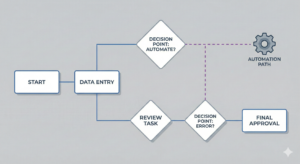
A workflow is the path a task follows from start to finish.
For example:
- A lead fills a form
- Someone calls the business
- An appointment is booked
- A follow-up message is sent
A smart workflow does all of this automatically and correctly.
Smart workflows:
- Follow clear rules
- React to real events
- Make decisions automatically
- Connect multiple systems
- Improve with data
They remove guesswork and manual work.
Why Most Businesses Struggle With Automation
Many businesses try automation and feel disappointed.
This happens because they automate without fixing the process first.
Common problems include:
- Automating broken workflows
- Using too many tools
- No clear goal for automation
- No testing before launch
- No ongoing improvement
Automation does not fix chaos.
It multiplies it.
An automation AI company avoids this by starting with strategy, not tools.
How an Automation AI Company Thinks Before Building

Before any system is built, an automation AI company asks important questions.
Understanding the Business
The first step is learning how the business actually works.
This includes:
- How leads come in
- How calls are handled
- How appointments are booked
- How follow-ups are done
- Where delays happen
Without this understanding, automation fails.
Identifying High Impact Areas
Not everything should be automated at once.
An automation AI company looks for:
- Tasks done every day
- Tasks that take too much time
- Tasks that affect revenue
- Tasks prone to mistakes
These areas deliver the biggest return.
Step One Mapping the Current Workflow
Workflow mapping is the foundation.
This means writing down every step of a process.
For example:
- Customer calls
- Staff answers
- Information is written manually
- Appointment is booked
- Follow-up is forgotten
Seeing the full picture helps identify problems.
It shows:
- Bottlenecks
- Delays
- Repeated work
- Missing steps
Only after this step does automation begin.
Step Two Defining Clear Automation Goals
Automation must solve a clear problem.
Goals may include:
- Faster response time
- Fewer missed calls
- More booked appointments
- Better customer experience
- Reduced manual work
Clear goals guide every decision.
Step Three Designing the Smart Workflow
This is where strategy turns into structure.
The workflow is broken into clear steps.
Each step answers:
- What triggers the action
- What happens next
- What decision is needed
- Where data goes
Smart workflows are simple.
They avoid unnecessary complexity.
Simple systems scale better.
Step Four Choosing the Right AI Tools
Tools are chosen after the workflow is designed.
An automation AI company selects tools based on need, not trends.
Common tools include:
- AI voice agents for calls
- AI chatbots for messages
- CRM systems for data
- Workflow automation platforms
- Calendar integrations
The goal is harmony, not tool overload.
Step Five Building and Connecting Systems
Once tools are selected, systems are connected.
This includes:
- Linking calls to CRM
- Syncing calendars
- Automating follow-ups
- Updating lead status
Data flows automatically without human input.
This reduces errors and saves time.
Step Six Testing the Workflow
Testing is critical.
An automation AI company tests:
- Normal scenarios
- Edge cases
- Failures
- Unexpected user behavior
Problems are fixed before launch.
This prevents costly mistakes.
Step Seven Launching the Workflow
Workflows are launched carefully.
This may include:
- Soft launches
- Limited user access
- Monitoring performance
Teams are informed and trained.
Feedback is collected early.
Step Eight Improving Over Time
Automation is not one-time.
Smart workflows improve with data.
An automation AI company:
- Reviews performance
- Adjusts rules
- Improves conversations
- Expands automation
As the business grows, workflows grow too.
Real Examples of Smart Workflows

Lead Handling Workflow
- Lead comes in
- AI qualifies the lead
- CRM updates automatically
- Follow-up is sent
- Sales team is notified
Appointment Booking Workflow
- Customer calls
- AI answers
- Calendar is checked
- Appointment is booked
- Confirmation is sent
Customer Support Workflow
- Customer asks a question
- AI provides instant answer
- Complex issues are escalated
- Ticket is logged automatically
Benefits of Smart Workflows
Smart workflows deliver real business results.
They provide:
- Faster operations
- Better accuracy
- Consistent service
- Lower costs
- Higher customer satisfaction
They also reduce stress for teams.
Automation AI Company vs DIY Automation
Many businesses try to build automation themselves.
This often leads to:
- Tool confusion
- Broken workflows
- Time wasted
- Poor results
An automation AI company brings experience, structure, and long-term thinking.
How FutureForge AI Solutions Builds Smart Workflows

FutureForge AI Solutions follows a business-first approach.
The focus is on:
- Understanding your operations
- Designing workflows that fit your business
- Building systems that work together
- Supporting growth over time
The goal is practical automation that delivers results.
Security and Reliability
Smart workflows must be secure.
Automation AI companies ensure:
- Secure data handling
- Reliable integrations
- System monitoring
- Backup processes
Trust is essential.
Signs You Need an Automation AI Company
You may need help if:
- Work feels chaotic
- Leads are missed
- Teams are overwhelmed
- Growth feels stuck
- Systems do not talk to each other
Automation brings clarity.
The Future of Smart Workflows
Smart workflows are becoming more intelligent.
Future systems will:
- Predict actions
- Personalize responses
- Adapt automatically
- Support decision making
Businesses that adopt early gain advantage.
Final Thoughts
Automation is not about replacing people.
It is about removing friction.
An automation AI company helps businesses build smart workflows that save time, reduce errors, and support growth.
When workflows are clear, businesses run better.
Smart automation creates freedom.


