
Running a small business today is very different from how it was even ten years ago.
Customers expect quick responses. They expect businesses to answer calls, reply to messages, and provide information almost instantly. When someone needs a service, they usually search online, contact several companies, and choose the one that responds first.
For many small businesses, this creates a serious challenge.
Most owners and teams are busy doing the real work of the business. Contractors are on job sites. Cleaning companies are moving between locations. Service teams are driving, installing equipment, or managing projects.
While all of this is happening, the phone is ringing. Messages are coming in through websites. Customers are asking questions through chat and social media.
If no one responds quickly, those opportunities disappear.
The problem is not always marketing. Many small businesses already receive leads. The real problem is response time.
This is where AI agents for small businesses are starting to change how companies operate.
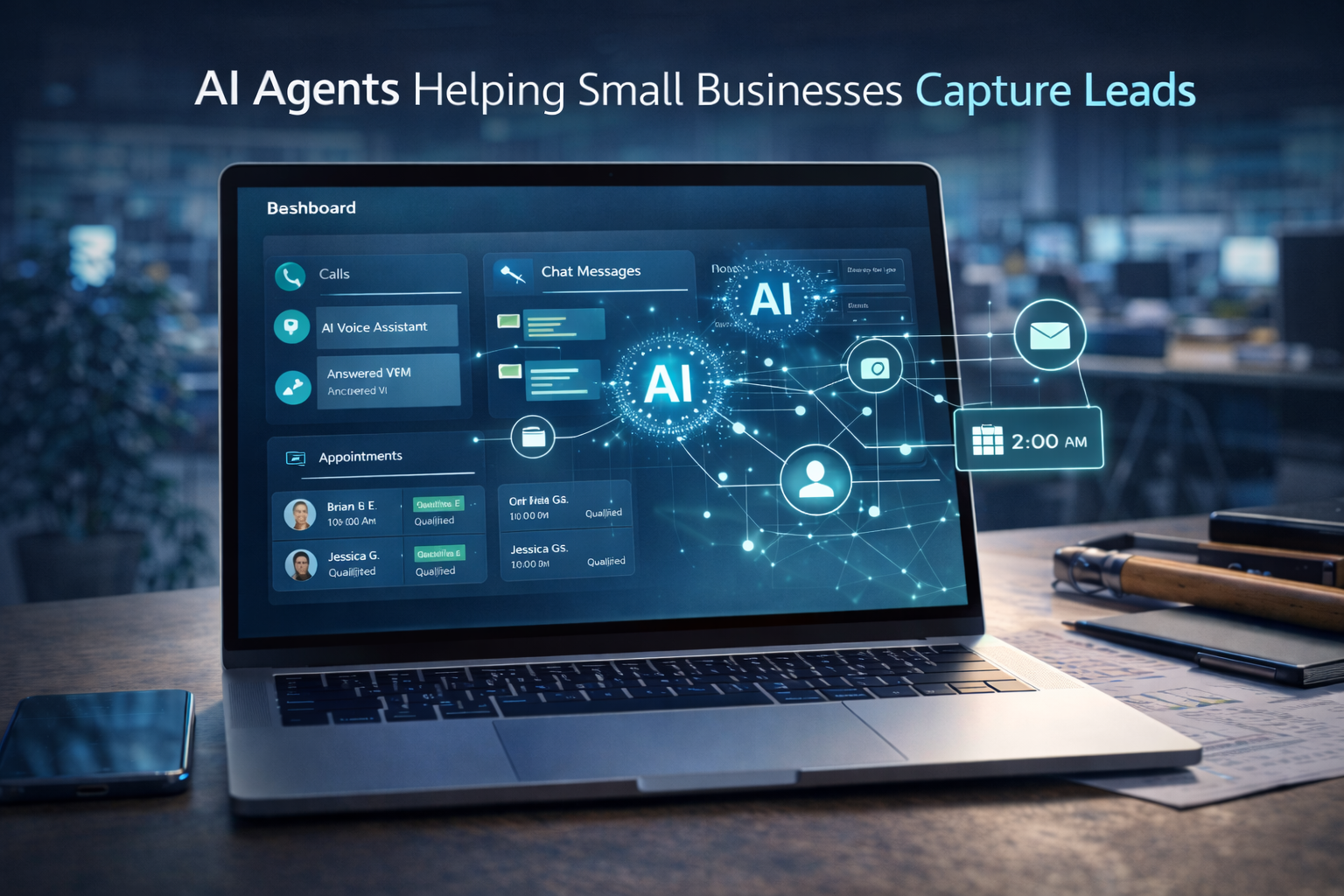
AI agents allow businesses to automate communication, capture leads automatically, and respond to customers instantly. Instead of missing opportunities, companies can create systems that work in the background while the team focuses on delivering services.
In this guide, we will explore how AI agents work, why small businesses are adopting them, and how automation is helping companies capture more leads and book more customers.
What Are AI Agents for Small Businesses?
AI agents are automated systems that use artificial intelligence to interact with customers and handle routine tasks.
These systems can understand questions, respond to conversations, collect information, and guide customers through simple processes.
In simple terms, an AI agent acts like a digital assistant for your business.
Instead of requiring a human to answer every call or message, the AI system can handle the first interaction.
AI agents can communicate with customers through several channels:
-Phone calls
-Website chat
-Text messages
-Email
-Messaging apps
For example, an AI agent might answer a phone call and ask the customer what service they need. It may collect the address of the project, ask when the customer wants the work completed, and schedule an appointment.
All of this can happen automatically.
The goal is not to replace employees. The goal is to remove the delays that happen when businesses cannot respond quickly enough.
Why Small Businesses Are Adopting AI Agents
Small businesses are adopting AI automation for several reasons.
Faster Customer Response
Speed is one of the biggest advantages in business communication.
Customers usually contact multiple companies when they need a service. The business that responds first often has the best chance of getting the job.
AI agents respond instantly. They do not wait for someone to check messages or return calls.
This fast response can dramatically improve lead conversion.
Reduced Workload for Business Owners
Small business owners already handle many responsibilities.
They manage operations, customer relationships, marketing, scheduling, and finances.
Answering every phone call and message can become overwhelming.
AI agents handle many of these conversations automatically. This reduces the workload on the team.
Capturing Leads Automatically
Many businesses lose leads without realizing it.
Customers call and reach voicemail. They send website messages that receive late responses. They leave websites without contacting the company.
AI systems help capture these leads automatically.
24 Hour Availability
Customers do not always contact businesses during normal hours.
Someone may search for services in the evening or late at night.
AI agents allow businesses to respond even when the office is closed.
The Real Lead Problem Small Businesses Face
Many businesses believe they need more leads.
They invest in advertising, SEO, and marketing campaigns to bring more people to their website or phone line.
However, the real issue often appears after the lead arrives.
Imagine a homeowner looking for a landscaping company.
They search online and find five different businesses.
They begin calling each company.
The first business does not answer. The call goes to voicemail.
The second business also does not answer.
The third business answers immediately.
Which company will likely get the job?
In most cases, the company that answered first.
This situation happens thousands of times every day across many industries.
Missed calls and slow responses cause businesses to lose opportunities they already paid to generate.
How AI Agents Capture Leads Automatically
AI automation solves this problem by creating systems that respond instantly.
Here is how the process works.
First, a potential customer contacts the business. They may call the phone number, visit the website, or send a message.
Instead of waiting for a human response, an AI agent begins the conversation immediately.
The system asks simple questions to understand the customer’s needs.
For example, the AI may ask:
What service are you looking for?
Where is the project located?
When would you like the work done?
Once the information is collected, the AI system can schedule an appointment or create a lead inside the business system.
The customer receives confirmation messages and follow-up communication automatically.
From the customer’s perspective, the business responded quickly and professionally.
From the business owner’s perspective, the system captured a new opportunity without manual effort.
AI Voice Agents: Never Miss Another Call
Phone calls remain one of the most important communication channels for many businesses.
This is especially true for service industries such as contractors, plumbers, electricians, cleaning companies, and landscapers.
Customers often prefer calling because it is the fastest way to get answers.
However, small businesses miss many calls because employees are busy working.
AI voice agents help solve this problem.
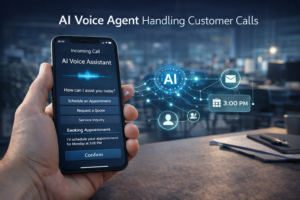
An AI voice agent answers incoming calls automatically.
The system speaks naturally with the customer and guides them through a simple conversation.
The AI may ask about the service request, location, or schedule.
After gathering the information, the system can book an appointment or notify the business owner.
Instead of losing calls, every conversation becomes a potential lead.
AI Chatbots: Turning Website Visitors Into Leads
Many businesses invest money in building websites and attracting visitors.
But most website visitors never contact the business.
They browse the site and leave.
AI chatbots help capture these visitors before they disappear.
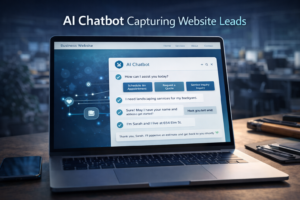
When someone visits the website, the chatbot can greet them and offer assistance.
It may ask questions such as:
How can we help you today?
What service are you looking for?
The chatbot can answer common questions and collect customer information.
It can also schedule appointments or send contact details to the business.
This turns passive website traffic into real leads.
AI Workflow Automation: Connecting Everything Together
AI communication tools become even more powerful when combined with automation workflows.
Workflow automation connects different tools and processes together.
For example, when a new lead is captured, the system may automatically:
Add the lead to a CRM system
Send a confirmation message
Schedule an appointment
Notify the business owner
Send reminders before the appointment
All of this happens automatically.
Automation reduces manual work and ensures that no lead is forgotten.
The Role of CRM Systems in AI Automation
A CRM system stores customer information and communication history.
When AI agents capture leads, that information can be stored inside the CRM.
This allows businesses to organize customer data and track conversations.
CRM systems also help businesses follow up with potential customers.
For example, if someone requests an estimate but does not schedule immediately, the system can send follow-up messages.
This helps increase the chances of converting leads into customers.
How GoHighLevel Powers AI Communication Systems
One of the most powerful platforms used for business automation is GoHighLevel.
GoHighLevel combines multiple tools into one system.
It includes features such as:
CRM management
AI voice agents
AI chatbots
Messaging automation
Appointment scheduling
Workflow automation
Businesses can manage all customer communication from a single dashboard.
Instead of using several different tools, everything operates inside one platform.
Automation agencies like FutureForge AI Solutions use GoHighLevel to build customized AI communication systems for businesses.
How FutureForge AI Solutions Helps Small Businesses
FutureForge AI Solutions focuses on helping businesses implement AI automation systems that capture leads and manage communication more effectively.
Instead of simply installing software, FutureForge builds complete automation systems designed around the needs of each business.
These systems often include:
AI voice agents that answer calls
AI chatbots that respond to website visitors
CRM systems that organize leads
Automation workflows that manage communication
The goal is to create a system that works quietly in the background while the business focuses on serving customers.
For many small businesses, this type of automation can significantly improve response time and lead management.
A Real Example of AI Automation in Action
Imagine a homeowner searching online for landscaping services.
They visit a company’s website.
A chatbot appears and asks how it can help.
The homeowner explains they need help with backyard landscaping.
The chatbot collects their contact information and schedules a consultation.
Later, the homeowner decides to call the company.
An AI voice agent answers the call and confirms the appointment.
All of the information is stored automatically in the CRM system.
The business owner receives the appointment details and can focus on preparing for the project.
This process happened automatically without requiring someone to manually answer messages or calls.
Benefits of AI Agents for Small Businesses
AI automation provides several benefits for small businesses.
Faster response times improve customer experience.
More leads are captured because communication happens instantly.
Administrative workload is reduced because many tasks are automated.
Customer information is organized inside CRM systems.
Businesses operate more efficiently and professionally.
Challenges and Considerations
AI automation is powerful, but it must be implemented correctly.
Businesses need to design automation workflows carefully.
AI systems should be trained to respond appropriately to common customer questions.
Human support is still important for complex situations.
When AI agents and human teams work together, communication becomes much more efficient.
The Future of AI Agents for Small Businesses
AI technology continues to improve rapidly.
Voice assistants are becoming more natural and conversational.
Chatbots are becoming better at understanding customer questions.
Automation systems are becoming easier to integrate with business software.
In the future, AI agents may become a standard tool used by most businesses.
Companies that adopt automation early will likely gain an advantage because they respond faster and manage leads more effectively.
Conclusion
Customer communication is one of the most important parts of running a successful business.
Many small businesses already generate leads but lose opportunities because they cannot respond quickly enough.
AI agents for small businesses help solve this problem.
By automating calls, chat messages, and communication workflows, businesses can capture leads instantly and respond to customers faster.
Platforms like GoHighLevel and automation providers such as FutureForge AI Solutions are making it easier for companies to implement these systems.
As artificial intelligence continues to evolve, businesses that adopt AI automation will be better positioned to compete, grow, and serve customers more effectively.


