
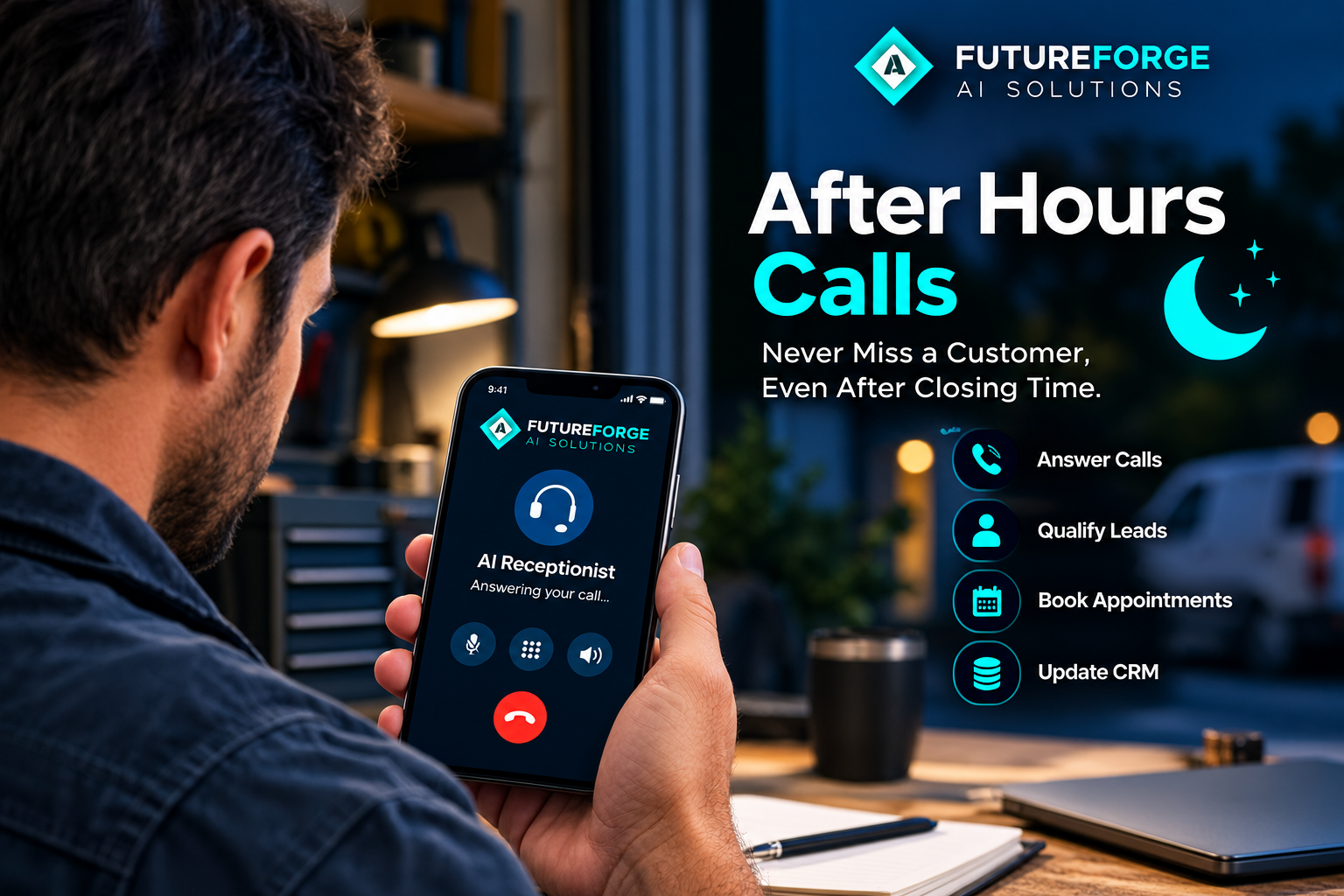
Your business may close at 5 or 6 PM, but your customers do not.
People search for contractors, service companies, healthcare providers, repair businesses, and other local services throughout the evening and on weekends. Some are researching their options. Others have an urgent problem and need help immediately.
When they call your business after hours and hear a voicemail greeting, you have no idea what happens next.
They might leave a message and wait.
Or they might hang up and call the next business.
For many small businesses, that second outcome is the real problem.
An after hours answering service gives businesses a way to handle calls when their regular team is unavailable. Depending on the service, calls can be answered by a live agent, an AI voice agent, or a combination of both. The service may answer questions, collect customer information, qualify leads, schedule appointments, route urgent calls, and send the details to your team.
For businesses that depend on phone calls to generate customers, after-hours coverage can turn missed opportunities into conversations.
What Is an After Hours Answering Service?
An after hours answering service is a phone answering solution that handles incoming calls outside your normal business hours.
Instead of sending every evening, overnight, weekend, or holiday call directly to voicemail, the call can be answered on behalf of your business.
The exact experience depends on the provider.
A traditional answering service may use live receptionists who follow a script or set of instructions provided by your company. An AI-powered service can use a voice agent that answers the phone, understands what the caller is saying, provides information, collects details, and performs actions such as scheduling an appointment.
Modern answering services can do much more than simply take a name and phone number. Some can qualify leads, synchronize with calendars, route calls based on urgency, send follow-ups, and provide call summaries to the business.
The basic idea is simple:
Your business may be closed, but your phone does not have to be.
Why Do Businesses Need After Hours Call Answering?
Many small business owners assume that customers will simply call back during business hours.
That is not always how customers behave.
Imagine someone needs an emergency plumber at 9:30 PM.
They search Google, find three plumbers, and start calling.
The first company does not answer.
The second company goes to voicemail.
The third company answers immediately.
The customer is likely to have a conversation with the third company.
The same principle applies outside emergency situations.
A homeowner might decide at 8 PM that they want an estimate for a new driveway. A property owner might need landscaping work on a weekend. Someone might want to schedule an HVAC service before leaving for work the next morning.
The customer does not necessarily care whether your office is officially open.
They care about getting an answer.
That is why an after hours phone answering service can be particularly useful for businesses that generate leads through phone calls.
What Happens When an After-Hours Call Goes to Voicemail?
Voicemail is not inherently bad.
It is still useful for many businesses.
The problem is relying on voicemail as the only way to handle after-hours customers.
When someone calls a business and nobody answers, several things can happen.
They may leave a voicemail.
They may send an email.
They may call again tomorrow.
Or they may simply move on.
For local service businesses, that last possibility matters.
A 2026 analysis of home-service contractors reported that 84% of calls placed after hours or on weekends went unanswered among businesses without call answering services. The same research reported that 72% of missed callers did not leave a voicemail.
Even if you do not use those figures to calculate your own potential losses, the underlying problem is easy to understand.
A customer cannot become a customer if your business never gets the opportunity to speak with them.
Why After-Hours Calls Can Be Valuable
Not every after-hours call is a high-value lead.
Some callers are looking for information.
Some want to compare prices.
Some may have a question that can wait until morning.
But some callers are ready to take action.
This is particularly important for home-service businesses.
Consider a few examples:
- A homeowner has a plumbing emergency at 10 PM.
- An HVAC customer loses heating on a winter evening.
- A property owner needs emergency electrical assistance.
- A homeowner wants to schedule a landscaping estimate.
- Someone is ready to move forward with a remodeling project.
- A customer wants to confirm an appointment for the following morning.
These customers are not necessarily going to wait until Monday morning.
For emergency services, the urgency is obvious.
For non-emergency services, the opportunity can still be significant because the customer may be actively searching for a company and comparing several options.
An answering service gives your business a way to engage with those callers instead of leaving the interaction entirely to voicemail.
How Does an After Hours Answering Service Work?
The process can be relatively simple.
Step 1: A customer calls your business
The customer calls your normal business number.
You do not necessarily need to advertise a separate after-hours number.
Depending on how the system is configured, your existing number can be forwarded to the answering service during specific hours.
For example, you could configure your phone system so that:
8 AM to 6 PM: Your normal team handles calls.
6 PM to 8 AM: Your after-hours answering service handles calls.
Weekends: Your after-hours service handles calls.
The exact setup depends on your phone system and provider.
Step 2: The call is answered
Instead of reaching voicemail, the customer gets an answer.
With a live answering service, a receptionist answers according to your instructions.
With an AI answering service, an AI voice agent handles the conversation.
The caller should still experience a business-specific conversation rather than a generic response.
For example, the system might know:
- Your business hours
- Services you provide
- Service areas
- Appointment availability
- Basic pricing information you choose to provide
- Emergency procedures
- Frequently asked questions
- How to contact your team
- What information should be collected from new leads
Step 3: The caller explains what they need
The system listens to the customer and determines what the conversation is about.
For example:
“I need an estimate for a new asphalt driveway.”
Or:
“My furnace stopped working and the house is getting cold.”
Or:
“I’d like to schedule a landscaping consultation.”
This is where an AI-powered system can be especially useful.
Instead of simply recording a message, the AI can follow a conversation designed around the business.
Step 4: The caller is qualified
The answering system can collect important information.
For a contractor, that might include:
- Customer name
- Phone number
- Email address
- Property address
- Type of project
- Approximate project size
- Timeline
- Service required
- Whether the situation is urgent
The exact questions should depend on the business.
The goal is not to interrogate the customer.
The goal is to collect enough useful information so the business knows what the opportunity looks like.
Step 5: The system can book an appointment
If your calendar is connected, an AI answering service may be able to schedule an appointment directly.
For example, a homeowner calls at 8:30 PM asking for a driveway estimate.
Instead of:
“Please leave a message and we’ll call you tomorrow.”
The system may be able to check available appointment times and offer the customer an appropriate slot.
The customer chooses a time.
The appointment is added to the calendar.
The customer receives confirmation.
Your team sees the appointment when they return to work.
That is a very different customer experience from voicemail.
Step 6: Your team receives the information
After the conversation, the business can receive the relevant information through the connected system.
Depending on the setup, this might include a notification, CRM record, call summary, transcript, appointment, or follow-up task.
The important thing is that the conversation does not disappear into a voicemail inbox.
Your team has something they can act on.
What Can an After Hours Answering Service Do?
The capabilities vary between providers, but a modern service can potentially handle much more than simply taking messages.
Answer common questions
An AI answering service can provide information about your business based on the knowledge and instructions you give it.
For example:
- What areas do you serve?
- What services do you offer?
- What are your normal business hours?
- Do you provide estimates?
- How can customers schedule an appointment?
- Do you offer emergency service?
This can save your team from answering the same basic questions repeatedly.
Capture new leads
A caller who reaches you after hours can still become a lead.
The system can collect the information your sales team needs and send it into your CRM or another connected workflow.
Qualify prospects
Not every caller is equally valuable.
Your system can ask questions designed to determine whether the caller is a good fit.
For example, a hardscaping company might want to know:
- What type of project are you considering?
- Where is the property located?
- When are you hoping to start?
- Are you looking for a driveway, patio, retaining wall, outdoor living space, or another service?
This creates a more useful lead for the business.
Book appointments
Appointment scheduling is one of the most useful features for many service businesses.
Instead of simply collecting the lead and waiting for someone to call back, the system can potentially move the customer directly toward the next step.
Route urgent calls
Not every call should follow the same process.
An emergency plumbing call at midnight should be treated differently from someone asking about a landscaping estimate for next spring.
An appropriately configured answering system can identify urgent situations and follow the escalation instructions established by the business.
Some modern services also support human escalation when the situation requires it.
Send follow-up
The conversation does not necessarily have to end when the customer hangs up.
Depending on the system, an automated workflow could send:
- Appointment confirmation
- Text message
- Lead notification
- Follow-up reminder
- Internal CRM task
This helps keep the information moving after the call.
AI vs Human After Hours Answering Services
One of the biggest decisions businesses face is whether to use a human answering service or an AI-powered answering service.
Both can work.
The better choice depends on your business, call volume, budget, and the type of conversations you receive.
Traditional live answering service
A live service uses human receptionists to answer calls.
This can be valuable when callers regularly need empathy, judgment, or complex conversations.
A human receptionist can also be helpful when your customers expect a highly personal experience.
However, live services can become more expensive as call volume and coverage requirements increase.
AI answering service
An AI answering service uses a voice agent to handle calls.
The major advantage is scalability.
An AI system can answer multiple calls without requiring another employee to physically answer the phone. It can also provide coverage outside normal business hours and follow predefined workflows consistently.
For repetitive calls, appointment booking, lead qualification, FAQs, and basic customer intake, AI can be a practical option.
Hybrid approach
Some businesses may benefit from both.
AI can handle routine calls and collect information while more complicated or sensitive situations are escalated to a human.
The goal should not be to choose AI simply because it is newer.
The goal is to determine which parts of your phone process should be automated and which should remain human.
After Hours Answering Service for Contractors
Contractors are one of the clearest examples of businesses that can benefit from after-hours call coverage.
The problem is not necessarily that contractors do not care about their customers.
It is that contractors are often physically unable to answer the phone.
They may be:
- Operating equipment
- Working on a roof
- Pouring concrete
- Installing an HVAC system
- Digging a trench
- Meeting with a homeowner
- Driving between jobs
- Working in a noisy environment
- Managing a crew
- Handling an emergency
Even during normal business hours, answering every call can be difficult.
After hours can be even more challenging.
A contractor may finish work at 6 PM, put the phone down, and finally have time to relax.
But potential customers are still searching.
For contractors, an after hours answering service can help create a bridge between the customer calling and the contractor becoming available.
Example: A hardscaping company
Imagine a homeowner finds your hardscaping company through Google at 8:15 PM.
They are interested in a new patio and retaining wall.
They call.
Normally, the call would go to voicemail.
Instead, your after-hours answering system picks up.
It asks what type of project they are considering, collects their property location, asks when they would like to start, and records their contact information.
If your calendar is configured for it, the system can offer an available consultation time.
By the next morning, your team already has the lead and the appointment.
The contractor did not have to answer the phone while relaxing at home.
The customer did not have to wait until morning to find out whether anyone could help.
That is the real value of the system.
After Hours Answering for HVAC, Plumbing and Electrical Companies
The same concept applies to other home-service businesses.
HVAC
HVAC calls can be particularly time-sensitive.
A homeowner may have no heating during cold weather or no air conditioning during extreme heat.
An after-hours system can collect information about the problem, determine whether the situation requires urgent attention, and follow the company’s escalation process.
Plumbing
A leaking pipe or overflowing fixture does not care what time it is.
A customer calling at 11 PM is likely looking for a company that can help now.
A phone system that simply says “leave a message” may not be enough.
Electrical
Electrical issues can range from routine service requests to situations requiring immediate attention.
An appropriately configured answering system can collect information and follow predefined procedures for urgent calls.
The important point is that the answering system should not pretend to be a technician.
It should handle communication and follow the instructions provided by the business.
After Hours Answering Service vs Voicemail
Voicemail is cheap.
In many cases, it is already included with your phone system.
So why pay for an answering service?
Because the two solutions perform different jobs.
With voicemail:
Customer calls → Nobody answers → Customer leaves message → Business follows up later
With an answering service:
Customer calls → Call is answered → Customer explains need → Information is collected → Lead is qualified → Appointment or next step is created
The difference is not simply that someone answers the phone.
The difference is what happens after the phone is answered.
That is what businesses should evaluate when comparing providers.
How Much Does an After Hours Answering Service Cost?
There is no single price for an after-hours answering service.
Pricing depends on factors such as:
- AI vs human answering
- Number of calls
- Number of minutes
- Hours of coverage
- Appointment scheduling
- CRM integrations
- Call transfers
- Human escalation
- Number of locations
- Custom workflows
- Additional communication channels
Current 2026 market examples show a wide range. Some AI services advertise relatively low monthly prices, while traditional human answering services can cost several hundred dollars per month or more depending on usage and coverage. One current contractor-focused source, for example, describes live receptionist plans commonly falling around $250 to $720 per month for meaningful call coverage, while AI plans can range from relatively low monthly fees to several hundred dollars depending on the provider and usage.
Because pricing models differ so much, it is better to compare the cost per captured opportunity rather than simply looking for the cheapest monthly plan.
Suppose your average booked job is worth $1,500.
If an answering service costs $200 per month and helps you capture one additional job, the calculation is very different from a service that costs $50 but does not actually handle your calls effectively.
The cheapest phone system is not necessarily the most profitable one.
Is an After Hours Answering Service Worth It?
For the right business, it can be.
But the answer depends on your numbers.
Start by looking at your own call history.
Ask:
- How many calls do we receive after hours?
- How many of those calls are missed?
- How many callers leave voicemails?
- How quickly do we normally call people back?
- How many missed callers eventually become customers?
- What is our average customer value?
- How many additional customers would cover the cost of the service?
You do not need complicated calculations.
For example, imagine a contractor receives 30 after-hours calls each month.
If even a small number of those calls turn into additional booked jobs, the service may pay for itself.
The key is to measure the outcome.
Do not judge the system simply by asking:
“How many calls did the AI answer?”
Ask:
“How many valuable opportunities did we capture that we would have otherwise missed?”
What Happens When AI Cannot Answer a Question?
This is an important question to ask before choosing an AI answering service.
AI should not be treated as an all-knowing employee.
A properly designed system needs boundaries.
If a customer asks something outside the information available to the system, it should not invent an answer.
Depending on the situation, it could:
- Ask for additional information
- Explain that someone from the team will follow up
- Transfer the caller
- Escalate the call
- Create a follow-up task
- Take a detailed message
The system should know what it is allowed to answer and what requires a human.
That is especially important for businesses where incorrect information could create a serious problem.
Good automation is not about making AI do everything.
It is about making AI handle the right things reliably.
What Should You Look For in an After Hours Answering Service?
Not every answering service is built the same way.
Before choosing one, look beyond the phrase “24/7 answering.”
Ask what actually happens when someone calls.
1. Can it understand your business?
A generic script may not be enough.
Your answering system should understand your services, service areas, common questions, and lead qualification process.
2. Can it book appointments?
If your business depends on estimates or consultations, appointment scheduling can be much more valuable than simple message-taking.
3. Can it integrate with your calendar?
A booking system is more useful when it connects to the calendar your team actually uses.
4. Can it connect with your CRM?
If every call creates a useful record in your CRM, your team has a much better chance of following up consistently.
5. Can it handle urgent calls?
If you operate in an industry where emergencies happen, ask exactly how urgent calls are identified and escalated.
6. Can it transfer calls when necessary?
Some conversations should involve a human.
Find out whether the system can transfer calls and what happens when the intended person is unavailable.
7. Can you customize the workflow?
Your business is not identical to another company’s.
You should be able to define what information is collected and what happens next.
8. Can you review conversations?
Call recordings, transcripts, summaries, or other reporting tools can help you identify problems and improve the system over time.
Why the Goal Should Not Be “Just Answer Every Call”
Answering every call sounds like the ultimate goal.
It is not.
The real goal is to create a better process for turning conversations into useful business opportunities.
Imagine two companies.
Company A answers every call but simply says:
“Someone will call you back tomorrow.”
Company B answers the call, understands what the customer needs, collects the project details, qualifies the opportunity, books an appointment when appropriate, and sends the information to the sales team.
Both answered the call.
But only one built a process around what happens next.
That is why modern answering services are becoming more than phone receptionists.
They are becoming part of the sales and customer-service workflow.
After Hours Answering Is Not Just About Nights
Although the term “after hours” usually means evenings, overnight periods, weekends, and holidays, the underlying problem can happen at any time.
A contractor can miss a call at 11 AM because they are on a roof.
A landscaper can miss a call while operating equipment.
A business owner can miss a call while meeting another customer.
An employee can miss a call while helping someone in the office.
So the bigger question is not:
“Who answers after 5 PM?”
It is:
“What happens when nobody is available to answer?”
An after-hours answering service can be one part of a broader call-handling system that covers those gaps.
The Future of Small Business Phone Answering
The traditional idea of an answering service was simple.
Someone called after hours.
A receptionist answered.
The receptionist took a message.
The business called back.
That model still has value.
But technology is changing what can happen during that conversation.
AI voice agents can now handle natural conversations, answer questions based on business information, qualify leads, schedule appointments, trigger workflows, and pass information into business systems.
That does not mean every business needs to replace human receptionists with AI.
It means businesses now have more options.
For a small company that cannot justify hiring another full-time employee simply to cover evening and weekend calls, an AI answering service may provide another way to create reliable phone coverage.
And for businesses with complex customer needs, a combination of AI and human support may make more sense.
The technology is only useful when it improves the customer experience and produces a useful business outcome.
A Simple Example of the Complete After-Hours Workflow
Let’s put everything together.
Imagine a homeowner searches for a hardscaping company at 8:45 PM.
They find your business and call.
Without an after-hours answering service:
The phone rings.
Nobody answers.
The caller reaches voicemail.
They do not leave a message.
They call another company.
You never know the opportunity existed.
With an AI answering service:
The phone rings.
The AI answers.
The customer explains that they want a new backyard patio.
The AI asks for the customer’s name, phone number, property location, project details, and expected timeline.
The customer qualifies as a potential project.
The AI checks available consultation times.
The customer books an appointment.
The appointment is added to the calendar.
The customer receives confirmation.
Your team receives the lead information.
The next morning, your team already knows who the customer is, what they want, and when they are scheduled to speak with you.
That is the difference between simply answering a phone and building a system around the phone.
Final Thoughts
An after hours answering service is not about convincing customers to call your business at night.
Customers are already calling.
The question is what happens when they do.
For a small business, especially a contractor or home-service company, missed calls can represent opportunities that never get a second chance.
You may be busy on a job.
Your team may have already gone home.
You may be driving.
It may be Saturday.
It may be midnight.
None of that changes the customer’s immediate need.
A modern answering service can help bridge that gap by answering calls, collecting information, qualifying leads, booking appointments, routing urgent requests, and keeping your team informed.
AI makes this even more practical for many small businesses because routine phone conversations can be handled automatically without requiring another employee to be available around the clock.
The important thing is choosing a system that fits your business rather than choosing technology simply because it sounds impressive.
Your customers do not care whether your phone system is powered by AI.
They care whether someone answers, understands what they need, and helps them take the next step.
And that is exactly what a good after hours answering service should help your business do.
How FutureForge AI Solutions Can Help
At FutureForge AI Solutions, we help businesses use AI and automation to improve the way they handle customer communication.
Our AI voice solutions can help businesses answer calls, handle common questions, qualify leads, follow up with prospects, and book appointments while your team is busy or unavailable.
For contractors and service businesses, this can be especially useful.
You can stay focused on the work while your phone system handles the repetitive parts of customer communication in the background.
Instead of relying entirely on voicemail and hoping customers call back, you can create a process designed to respond faster and capture more opportunities.
If your business is receiving calls after hours, while your team is on jobs, or when nobody is available to answer, an AI answering solution may be worth exploring.
Visit FutureForge AI Solutions to learn how AI voice agents and business automation can help your company handle more calls and follow up with more opportunities.
Frequently Asked Questions
What is an after hours answering service?
An after hours answering service handles business phone calls outside normal operating hours. Depending on the provider, calls may be answered by live receptionists, AI voice agents, or a combination of both.
Is an after hours answering service only for emergencies?
No. It can handle emergency calls, but it can also answer general questions, capture leads, qualify prospects, schedule appointments, and provide information about your business.
Can an AI answering service book appointments after hours?
Yes, if the system is configured with access to an appropriate calendar and booking workflow. It can potentially check availability and schedule appointments during evenings, weekends, and other periods when your staff is unavailable.
Can an answering service work for contractors?
Yes. Contractors are a strong use case because they are often unable to answer calls while working on job sites. An answering service can help capture customer information and handle calls while the contractor is busy.
Can an AI answering service handle emergency calls?
It can be configured to identify certain urgent situations and follow predefined escalation procedures. However, the system should not pretend to be a technician or provide professional advice outside its intended role.
Is AI better than a human answering service?
Neither is automatically better for every business. AI can provide fast, consistent coverage and handle repetitive conversations at scale. Human receptionists can be valuable for complex or sensitive conversations. Some businesses may benefit from a hybrid approach.
Does an after hours answering service replace my employees?
Not necessarily. The purpose can be to handle routine calls and repetitive communication so your employees can focus on work that requires human judgment and attention.
Can an answering service connect to my CRM?
Many modern answering solutions support CRM or workflow integrations, but the exact integrations depend on the provider and your existing systems.
How much does an after hours answering service cost?
Pricing varies widely depending on whether the service uses AI or live agents, the number of calls or minutes, coverage hours, integrations, appointment scheduling, and other features. Businesses should compare the cost against the value of the calls they expect to capture.
Is an after hours answering service worth it for a small business?
It can be, especially if your business receives valuable calls outside normal hours or regularly misses calls because your team is busy. The best way to evaluate it is to compare your missed-call volume, average customer value, and booking rate against the cost of the service.
What should happen when the AI cannot answer a question?
A good system should have a defined fallback process. It may collect the customer’s information, transfer the call, escalate the request, or create a follow-up task for a member of your team. It should not invent an answer simply to keep the conversation going.
Do I need a separate phone number?
Not necessarily. Depending on your existing phone system and the answering service, your current business number can often be forwarded to the service during specific hours.
Can I use an answering service only after business hours?
Yes. Many businesses configure their systems specifically for evenings, overnight periods, weekends, holidays, or other times when their normal staff is unavailable.
What is the difference between an answering service and an AI receptionist?
The terms overlap. An answering service generally refers to a solution that handles incoming calls, while an AI receptionist is typically an AI-powered system designed to interact with callers, answer questions, qualify leads, schedule appointments, and perform other receptionist tasks.
Can an AI answering service follow up with missed leads?
Depending on the system and integrations, it can trigger automated follow-up actions such as text messages, emails, CRM tasks, or notifications. The exact workflow depends on how the system is configured.


