

Many businesses talk about AI.
Very few actually make it work.
Some try AI tools.
Some buy software.
Some hear big promises.
But after a few months, nothing really changes.
The business still feels busy.
The team is still stressed.
Customers still wait.
Leads still get missed.
So the real question is not
Does AI exist
The real question is
How do you use AI for business automation that actually works
This blog explains everything in simple way.
What Business Automation Really Means
Business automation means using systems to handle work automatically.
This includes tasks like:
- Answering customer questions
- Handling phone calls
- Sending follow ups
- Booking appointments
- Updating CRM systems
- Managing workflows
Automation removes manual effort.
When AI is added, automation becomes smarter.
AI can understand.
AI can decide.
AI can improve over time.
This is what makes automation actually work.
Why Most AI Automation Fails
Before talking about success, we need to talk about failure.
Most AI automation fails for simple reasons.
No Clear Goal
Many businesses start with AI without knowing why.
They use AI because it sounds modern.
But they do not define:
- What problem to solve
- What task to automate
- What result they want
Without a goal, AI becomes useless.
Too Many Tools
Some businesses add many tools.
Chatbot here.
CRM there.
Email tool somewhere else.
Nothing is connected.
This creates confusion, not automation.
No Real Workflow
AI needs structure.
If your business process is unclear, AI cannot help.
Automation must follow real workflows.
Expecting AI to Replace Strategy
AI is not magic.
It supports strategy.
It does not replace thinking.
What AI for Business Automation That Works Looks Like
Working AI automation follows simple rules.
It Solves a Real Problem
It removes pain.
Missed calls
Slow replies
Manual follow ups
Admin overload
If AI fixes a real issue, it works.
It Fits the Business
Good AI automation is customized.
It matches how the business works.
Not the other way around.
It Runs in the Background
Good automation feels invisible.
Work gets done.
Results appear.
Stress reduces.
That is success.
Core Areas Where AI Automation Actually Works

Let us look at where AI brings real results.
AI for Customer Communication
This is one of the strongest areas.
AI Chatbots for Business
AI chatbots answer customer questions instantly.
They work on:
- Websites
They help customers:
- Get information
- Book appointments
- Ask questions
Businesses benefit because:
- No waiting
- No missed messages
- 24/7 support
This is AI automation that works.
AI Voice Agents for Calls
Calls are critical.
Missed calls mean lost money.
AI voice agents:
- Answer calls day and night
- Book appointments
- Collect lead information
- Handle basic sales
They sound natural.
They follow scripts.
They never get tired.
This works especially well for:
- Service businesses
- Clinics
- Contractors
- Agencies
AI for Lead Management
Leads need fast response.
AI automation helps by:
- Capturing leads
- Qualifying them
- Sending follow ups
- Updating CRM
Sales teams get better leads.
No manual chasing.
AI for Sales Automation
AI helps sales teams work smarter.
It can:
- Track conversations
- Suggest next steps
- Send reminders
- Follow up automatically
Sales become consistent.
Deals close faster.
AI for Marketing Automation
Marketing needs speed and timing.
AI automation helps with:
- Email campaigns
- Message follow ups
- Lead nurturing
- Customer segmentation
Marketing becomes more personal and effective.
AI for Internal Operations
Many businesses waste time internally.
AI automation handles:
- Task assignments
- Data updates
- Reporting
- Workflow tracking
Teams focus on meaningful work.
Why AI Automation Works Better Than Manual Systems
Manual systems depend on people.
People get busy.
People forget.
People make mistakes.
AI systems are:
- Consistent
- Fast
- Accurate
This is why automation works long term.
AI Automation for Small Businesses
Small businesses benefit the most.
They have:
- Small teams
- Limited time
- Tight budgets
AI helps them:
- Look professional
- Respond faster
- Compete with larger companies
AI becomes a silent team member.
Real Life Example
A small service business receives many calls.
Before AI:
- Missed calls
- Lost leads
- Manual booking
After AI automation:
- AI answers calls
- Books appointments
- Sends confirmations
The owner focuses on service.
Revenue grows.
This is AI that works.
How to Build AI Automation That Actually Works
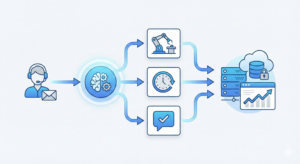
Building AI automation is not about installing software and hoping for results.
It is about understanding your business first.
When AI automation works, it feels simple.
When it fails, it feels confusing and heavy.
Here is how to build AI automation that actually works, step by step.
Step One Identify Repetitive Tasks in Your Business
The first step is awareness.
Look at your daily operations.
Ask yourself:
- What tasks do we repeat every day
- What tasks take time but do not create real value
- What work feels boring or exhausting
Common examples include:
- Answering the same customer questions
- Taking calls and collecting basic information
- Sending follow up messages
- Updating spreadsheets or CRM systems
- Booking and confirming appointments
These tasks are perfect for AI automation.
If a task happens again and again, AI should handle it.
Step Two Choose One Process and Focus on It
Many businesses make a big mistake here.
They try to automate everything at once.
This creates confusion and failure.
Instead, choose one process.
Just one.
For example:
- Handling incoming website messages
- Answering phone calls
- Managing lead follow ups
Focus on one area where improvement will make the biggest difference.
When one process works well, confidence grows.
Then you can expand.
Step Three Map the Workflow Before Using AI
AI cannot fix chaos.
Before automation, you need clarity.
Write down the steps of the process.
Example:
- A customer contacts the business
- Information is collected
- Action is taken
- Follow up is sent
Keep it simple.
Clear steps help AI understand what to do.
This step is critical.
Good automation always starts with a clear workflow.
Step Four Choose AI Tools That Match the Workflow
Not all AI tools are the same.
Some are good for chat.
Some are good for calls.
Some are good for data.
Choose tools based on the task, not trends.
Ask:
- Does this tool solve my exact problem
- Can it integrate with my systems
- Is it easy to manage
Simple tools that fit your workflow work better than complex platforms.
Step Five Connect AI With Your Existing Systems
AI should not work alone.
It must connect with:
- Your website
- Your CRM
- Your calendar
- Your messaging platforms
This connection allows automation to flow.
When systems talk to each other, work happens automatically.
This is where AI for business automation starts feeling powerful.
Step Six Test AI in Real Scenarios
Never assume automation works perfectly from day one.
Test it like a customer.
Call your business.
Send messages.
Fill out forms.
Check:
- Is the response correct
- Is the tone natural
- Is the action accurate
Testing helps find small issues before they become big problems.
Step Seven Improve Based on Real Feedback
AI for business automation improves with feedback.
Look at:
- Customer responses
- Missed questions
- Confusing replies
Adjust scripts.
Improve logic.
Refine responses.
Small improvements make a big difference over time.
Step Eight Let AI Own the Task Fully
This step is important.
Do not hover over AI.
Once it works, let it run.
If humans keep interfering, automation loses power.
AI needs ownership to create real leverage.
Trust the system.
Step Nine Measure Results Regularly
You should track simple results.
Examples:
- Time saved per week
- Number of calls answered
- Leads captured
- Follow ups completed
If results improve, AI for business automation is working.
If not, adjust.
Step Ten Expand Automation Slowly
After one process works well, add another.
Step by step.
This keeps automation clean and manageable.
Growth becomes easy instead of chaotic.
Why Custom AI Automation Beats Generic Tools
Generic tools are built for everyone.
Custom AI is built for you.
Custom automation:
- Matches your workflow
- Solves your problems
- Scales with growth
This is why working with an AI automation company helps.
The Role of an AI Automation Company

A good AI automation company:
- Understands your business
- Designs workflows
- Builds automation
- Maintains systems
This saves time and avoids mistakes.
Signs Your AI for Business Automation Is Working
You will notice:
- Fewer manual tasks
- Faster response times
- Happier customers
- Better organization
- More time for growth
If you feel calmer, it is working.
Common Mistakes to Avoid
Avoid:
- Over automation
- Poor planning
- Too many tools
- Ignoring feedback
Simple systems work best.
The Future of AI for Business Automation
AI will become:
- More natural
- More affordable
- More powerful
Businesses that start now will lead later.
Those who wait will struggle.
Final Thoughts
AI for business automation that actually works is not about hype.
It is about:
- Solving real problems
- Saving time
- Improving experience
- Supporting growth
When done right, AI becomes a quiet partner in your business.
It works while you focus on what matters most.


