
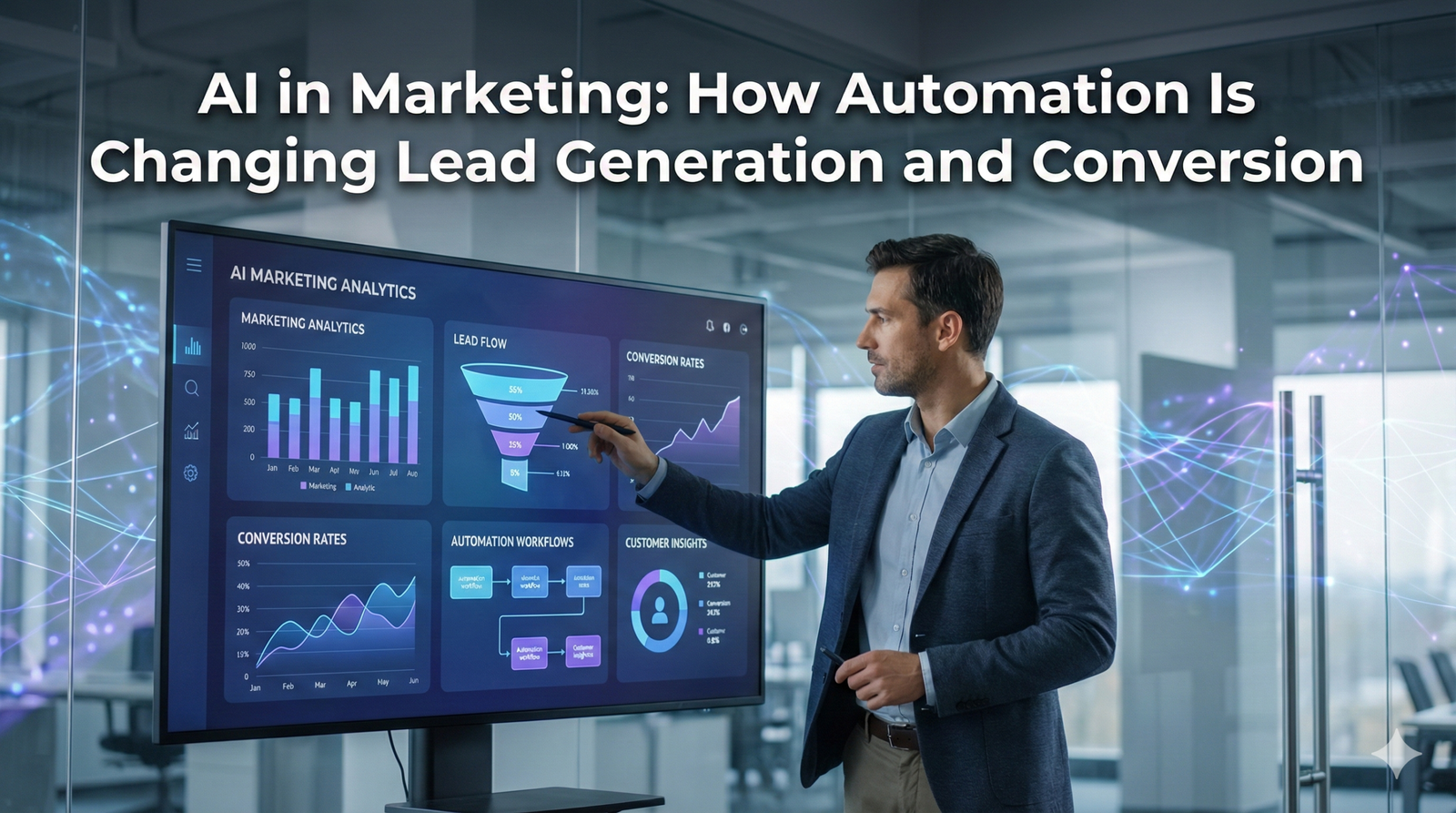
Marketing has changed more in the last five years than it did in the previous twenty.
Customers move fast. They compare options instantly. They expect quick replies. They want personalized experiences. If a business responds slowly or sends generic messages, the customer simply moves on.
This is where AI in marketing is transforming everything.
Artificial intelligence is no longer just a trend. It is becoming the backbone of modern lead generation and conversion systems. It helps businesses attract better prospects, respond faster, personalize communication, and convert more customers without increasing workload.
But here is something important. AI is not replacing marketers. It is helping them make smarter decisions and automate repetitive tasks so they can focus on strategy and creativity.
In this guide, you will learn how AI in marketing is changing lead generation and conversion in 2026. You will understand how it works, why it matters, and how businesses can use it effectively without making common mistakes.
Let us break it down step by step.
What Is AI in Marketing?
AI in marketing means using artificial intelligence technologies to improve marketing activities such as targeting, content creation, lead scoring, customer engagement, and conversion optimization.
In simple words, AI helps marketers use data more intelligently.
Traditional marketing automation follows fixed rules. For example, if someone downloads a guide, they receive a pre-written email sequence. It works, but it is limited.
AI-driven marketing goes further. It analyzes behavior, patterns, preferences, and engagement data in real time. It learns from results. It adjusts strategies automatically.
AI in marketing often includes:
- Machine learning to analyze customer behavior
- Predictive analytics to forecast future actions
- Personalization engines to customize content
- Smart chatbots for lead qualification
- Automated campaign optimization
The key difference is intelligence.
Traditional automation follows instructions.
AI automation adapts and improves.
That difference is what makes it powerful.
Why Traditional Lead Generation Is No Longer Enough
Lead generation used to be simple.
Run ads. Collect emails. Send newsletters. Call prospects. Close deals.
Today, that approach is not enough.
Here is why.
First, customers are overloaded with information. They receive hundreds of marketing messages every week. Generic communication does not stand out.
Second, manual follow-ups are slow. If a prospect fills out a form and waits hours for a response, interest decreases.
Third, targeting is more complex. People use multiple devices and platforms. Understanding behavior manually is nearly impossible.
Fourth, competition is global. Your competitor may respond instantly using AI tools.
Traditional lead generation struggles because it relies heavily on human effort and static processes.
AI in marketing solves these issues by making systems dynamic and responsive.
Instead of guessing, AI analyzes data.
Instead of waiting, AI responds instantly.
Instead of sending generic messages, AI personalizes communication.
This shift is changing how businesses attract and convert customers.
How AI Is Transforming Lead Generation
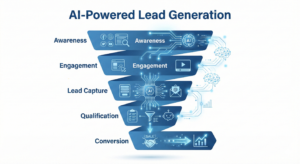
Lead generation is the first step in revenue growth. If you attract the wrong leads, your sales team wastes time. If you miss high-intent prospects, you lose money.
AI improves this entire process.
AI-Powered Targeting
AI tools analyze user behavior, browsing history, engagement patterns, and demographic data.
Instead of targeting broad audiences, AI identifies people who are most likely to convert.
For example, if someone visits pricing pages multiple times, downloads a product guide, and spends time reading comparison content, AI detects buying signals.
This allows businesses to focus ad budgets and marketing efforts on high-intent prospects.
Smarter targeting reduces cost and increases quality.
Smart Lead Scoring
Lead scoring ranks prospects based on their likelihood to convert.
In the past, scoring was rule-based. For example, 10 points for downloading a guide, 20 points for attending a webinar.
AI makes this more accurate.
It analyzes historical conversion data and identifies patterns. It learns which behaviors actually lead to sales.
As a result, sales teams focus on leads with real potential instead of wasting time on low-quality prospects.
This improves efficiency and increases close rates.
AI Chatbots for Lead Capture
Many businesses lose leads outside business hours.
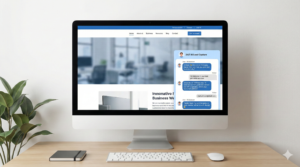
AI chatbots solve this problem.
They engage website visitors instantly. They answer common questions. They collect contact details. They qualify leads automatically.
A chatbot can ask:
What service are you looking for?
What is your budget range?
When would you like to start?
By the time a human representative connects, the lead is already pre-qualified.
This shortens the sales cycle significantly.
Predictive Analytics for Campaign Planning
Predictive analytics uses historical data to forecast future behavior.
AI tools can predict which type of campaign will perform best. They can suggest the best time to send emails. They can identify which audience segments are most responsive.
This reduces guesswork.
AI in marketing allows businesses to plan campaigns based on data rather than assumptions.
How AI Improves Conversion Rates
Generating leads is only half the process. Conversion is where revenue happens.
AI helps turn interest into action.
Personalized Customer Journeys
Modern customers expect personalization.
AI tracks user behavior across websites, emails, and ads. It understands what content someone reads, what products they view, and how they interact.
Based on this data, AI delivers personalized experiences.
For example:
A returning visitor sees different homepage content than a new visitor.
An email subscriber receives product recommendations based on past behavior.
Personalization increases trust and relevance. Relevance increases conversion.
AI Email Automation
Email marketing is still powerful. But manual email campaigns are limited.
AI analyzes open rates, click rates, and engagement timing. It determines when each individual is most likely to open an email.
It can adjust subject lines. It can personalize content blocks. It can automatically trigger follow-ups based on user actions.
This level of intelligence improves conversion without increasing workload.
AI for Sales Follow-Ups
Many deals are lost because of poor follow-up.
AI integrated with CRM systems can:
- Send reminders to sales teams
- Trigger automatic follow-up emails
- Alert teams when a lead shows renewed interest
For example, if a prospect revisits your website after two weeks of silence, AI can notify the sales representative immediately.
Timing is critical in sales. AI improves timing.
AI for Conversion Rate Optimization
Conversion rate optimization involves improving landing pages, calls to action, and user experience.
AI can run multiple variations of headlines, images, and layouts. It analyzes which version performs better.
Instead of waiting weeks for manual A/B testing, AI systems learn continuously and adjust in real time.
This makes conversion improvement faster and more accurate.
Real Business Use Cases
Let us look at practical examples of AI in marketing.
Example 1: Local Service Business
A local home services company installs an AI chatbot on its website.
The chatbot answers common questions, collects customer details, and schedules appointments automatically.
Result:
More bookings outside business hours.
Fewer missed inquiries.
Better-qualified leads.
Example 2: Ecommerce Store
An online store uses AI to recommend products based on browsing history and past purchases.
Customers see personalized suggestions that match their interests.
Result:
Higher average order value.
Better customer experience.
Increased repeat purchases.
Example 3: B2B Company
A B2B software company uses AI-powered lead scoring.
Sales teams focus only on leads with strong buying signals.
Result:
Shorter sales cycles.
Higher conversion rates.
Improved productivity.
These examples show that AI in marketing is not theoretical. It delivers practical results when used strategically.
Key Benefits of AI in Marketing
AI provides multiple advantages for businesses of all sizes.
Faster Response Time
AI systems respond instantly. This increases engagement and reduces lead loss.
Higher Quality Leads
Predictive analytics improves targeting and lead scoring.
Lower Customer Acquisition Cost
Better targeting means less wasted ad spend.
Improved Customer Experience
Personalized communication builds stronger relationships.
Data-Driven Decision Making
AI analyzes large data sets that humans cannot process manually.
Scalable Growth
AI systems can handle increasing workloads without increasing team size.
These benefits explain why AI in marketing is becoming essential rather than optional.
Common Mistakes Businesses Make
Despite its potential, many businesses misuse AI.
Here are common mistakes.
Buying Tools Without Strategy
Tools alone do not create results. Clear goals and structured planning are required.
Over-Automation
Automating everything can remove the human touch. Balance is important.
Ignoring Integration
AI tools must connect with CRM systems, email platforms, and analytics tools.
Not Tracking Performance
AI improves performance only when results are monitored and optimized.
Avoiding these mistakes ensures long-term success.
How to Build an AI Marketing Strategy for 2026
If you want real results, follow this framework.
Step 1: Define Clear Goals
Do you want more leads? Better conversion? Lower ad costs?
Clarity comes first.
Step 2: Map the Customer Journey
Understand how customers move from awareness to purchase.
Identify gaps where automation can help.
Step 3: Identify Repetitive Tasks
Look for tasks that consume time but follow patterns.
These are strong automation opportunities.
Step 4: Choose the Right Tools
Select tools that integrate easily and match your goals.
Step 5: Integrate and Test
Start small. Measure results. Improve gradually.
Step 6: Monitor and Optimize
AI systems improve with data. Continuous optimization is key.
A structured strategy ensures AI supports growth rather than creating confusion.
The Future of AI in Marketing
The future looks even more intelligent.
AI voice agents will handle customer calls.
Real-time personalization will become standard.
Predictive content creation will speed up campaigns.
AI-powered sales assistants will support closing deals.
Businesses that adopt AI strategically will gain competitive advantage.
Those who ignore it may struggle to keep up.
Frequently Asked Questions
What is AI in marketing?
AI in marketing refers to the use of artificial intelligence technologies to improve targeting, personalization, automation, and performance optimization.
Can small businesses use AI in marketing?
Yes. Many tools are affordable and scalable. Even small businesses can automate lead capture and email marketing.
Does AI replace marketers?
No. AI supports marketers by handling repetitive tasks and analyzing data. Strategy and creativity still require human expertise.
Is AI marketing expensive?
Costs vary. However, improved targeting and automation often reduce overall marketing expenses.
Final Thoughts
AI in marketing is changing how businesses generate leads and convert customers.
It improves targeting.
It speeds up response time.
It personalizes communication.
It supports smarter decision making.
But the real advantage comes from strategy.
AI is not magic. It is leverage.
Businesses that combine intelligent automation with human creativity will build stronger systems, improve customer relationships, and grow sustainably in 2026 and beyond.
The question is not whether AI will shape marketing.
It already is.
The real question is whether your business is ready to use it wisely.


