
Artificial intelligence is no longer something only big tech companies use. In 2026, businesses of every size are using AI to automate work, improve marketing, increase sales, and serve customers faster. But there is one big problem. There are too many tools in the market.
Every software claims to be the best. Every website says their solution will save time and increase profit. As a business owner, it becomes confusing. Which tool is right for you? Which one will actually help your company grow? And how do you avoid wasting money on something you will never fully use?
This guide will help you understand how to choose the best ai tools for business in 2026. We will break everything down step by step in simple words. By the end of this article, you will know how to evaluate AI tools clearly, confidently, and professionally.
Why Choosing the Right AI Tool Matters More in 2026
The AI market has grown very fast. New tools are launching every month. Some focus on marketing. Some focus on automation. Some promise to replace full teams.
But buying the wrong tool can create serious problems.
You may spend thousands of dollars on subscriptions you do not use. Your team may feel confused and overwhelmed. Different tools may not connect with each other. Data security may become a risk. Instead of improving productivity, you may create more chaos.
AI is powerful. But only when it is used correctly.
Choosing the best ai tools for business is no longer about testing something new. It is about building a smart system that supports your long-term growth.
In 2026, AI is not optional. But strategy is more important than software.
Step 1: Define Your Business Goal First
Before you look at any tool, you need clarity.
Ask yourself one simple question. What problem am I trying to solve?
Many businesses make the mistake of buying AI tools because they look impressive. But tools do not create results. Clear goals do.
Here are common business goals where AI can help:
- Increase revenue
- Generate more leads
- Improve customer service
- Reduce operational cost
- Automate repetitive tasks
- Improve marketing performance
Think in this simple framework:
Problem → Process → Automation Opportunity
Example:
If your problem is missing customer calls, the process is phone handling. The automation opportunity may be an AI voice agent or virtual receptionist.
If your problem is slow response to website visitors, the process is customer communication. The automation opportunity may be an AI chatbot.
When you define your goal clearly, it becomes much easier to choose the best ai tools for business that match your needs.
Step 2: Identify Where AI Can Create the Biggest Impact
Not every department needs AI at the same time. You should start where the impact is highest.
AI for Marketing

Marketing is one of the biggest areas where AI creates value.
AI tools can help with:
- Content generation
- Social media scheduling
- Ad campaign optimization
- Email automation
- Lead scoring
- Audience analysis
If your marketing team struggles with content consistency or campaign performance, AI can improve efficiency and targeting.
But remember, AI should support your marketing strategy. It should not replace it.
AI for Customer Support
Customers expect fast replies in 2026. They do not want to wait hours for answers.
AI tools can help with:
This reduces workload on your team and improves customer experience.
If you want better support without increasing staff cost, this is where you may find the best ai tools for business.
AI for Operations
Operations often include repetitive tasks.
AI can automate:
This saves time and reduces human error.
AI for Sales
Sales teams benefit from automation as well.
AI can help with:
- Lead qualification
- Follow up reminders
- Sales email personalization
- Predictive analytics
- Sales performance tracking
When you understand where AI creates the biggest impact, you can prioritize your investment wisely.
Step 3: Understand the Different Types of AI Tools
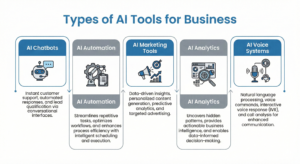
Not all AI tools are the same. Many business owners think AI is one single type of software. It is not.
Here are the main categories:
Generative AI Tools
These tools create content such as text, images, or videos. They help marketing teams create faster.
AI Automation Platforms
These tools connect different systems and automate workflows between them.
These tools handle website conversations and answer customer questions automatically.
These tools answer phone calls, schedule appointments, and provide voice-based assistance.
AI Analytics Tools
These tools analyze business data and provide insights for better decision-making.
Understanding these categories will help you compare tools correctly. You cannot compare a chatbot with an automation platform. They serve different purposes.
When searching for the best ai tools for business, always compare tools within the same category.
Step 4: Check Integration and Compatibility
This step is very important.
Many businesses buy best ai tools for business that do not connect with their existing systems.
Before choosing any AI software, ask:
- Does it integrate with your CRM?
- Does it connect to your website?
- Can it work with your email marketing tool?
- Does it support API access?
- Can it connect with your payment system?
If tools cannot communicate with each other, you create data silos. That leads to manual work again.
The-best ai tools for business should fit into your current ecosystem smoothly.
Integration is not optional. It is essential.
Step 5: Evaluate Security and Data Protection
AI tools handle sensitive data.
Customer information. Payment details. Business records.
Before choosing a tool, check:
- Where is the data stored?
- Is the data encrypted?
- Does the company follow compliance standards?
- What happens if there is a data breach?
Trust is everything in business.
If your customers feel their data is not safe, your reputation suffers.
Security should always be part of your decision process.
Step 6: Compare Cost Versus Return on Investment
AI tools usually work on monthly subscription models.
But subscription price is not the full cost.
You must consider:
- Setup cost
- Training cost
- Integration cost
- Maintenance cost
Then compare it with expected return.
For example:
If an AI chatbot costs 300 dollars per month but helps you capture 10 extra leads that convert into 5000 dollars revenue, the investment makes sense.
If you pay for multiple tools that you barely use, that is wasted money.
Choosing the best ai tools for business means choosing tools that generate measurable value.
Step 7: Test Before Full Implementation
Do not implement AI across your entire company immediately.
Start small.
Run a pilot project. Test one department. Measure results.
Check:
- Is productivity improving?
- Is customer satisfaction better?
- Is revenue increasing?
- Is your team comfortable using the tool?
After testing, you can scale gradually.
This reduces risk and ensures smoother adoption.
Common Mistakes Businesses Make When Choosing AI Tools

Many companies repeat the same mistakes.
They buy trendy tools without strategy.
They expect instant results.
They do not train their team properly.
They use too many tools at once.
They ignore integration.
They do not measure performance.
AI is powerful. But without proper planning, it becomes expensive software.
Avoid these mistakes if you want to truly benefit from the best AI tools for business.
What Makes the Best AI Tools for Small Business in 2026
Small businesses have different needs compared to large corporations.
The best AI tools for business at small scale usually have these features:
- Easy to use interface
- Affordable pricing
- Simple integration
- Strong customer support
- Clear documentation
- Scalable features
Small businesses need tools that save time, not create complexity.
Simplicity often wins over advanced features.
When Should You Work with an AI Consulting Company
Sometimes choosing the right tool is not enough.
You may need help designing the full AI strategy.
An AI consulting company can help with:
- Identifying automation opportunities
- Designing custom workflows
- Integrating tools properly
- Training your team
- Building long-term AI roadmap
If your company is growing fast or planning digital transformation, professional guidance can prevent costly mistakes.
AI works best when it becomes part of your overall business system.
Final Checklist Before You Choose Any AI Tool

Before making the final decision, review this checklist:
- What exact problem does this tool solve?
- Does it integrate with my current systems?
- Is the cost justified by expected return?
- Is customer data secure?
- Can this tool scale with my business?
- Does my team understand how to use it?
- Is there support available if needed?
If you can confidently answer these questions, you are closer to choosing the right solution.
Frequently Asked Questions
What are the best AI tools for business in 2026?
The best AI tools for business depend on your goals. For marketing, you may need content and ad optimization tools. For customer support, chatbots and AI voice systems work well. For operations, automation platforms are useful. There is no single best tool for every company.
Are AI tools expensive?
Some tools are affordable, especially for small businesses. But total cost includes setup and training. You should always compare cost with expected return.
Do small businesses really need AI?
Yes. Small businesses can benefit greatly from automation. AI helps save time, reduce manual work, and improve customer experience.
How long does it take to see results?
It depends on the tool and implementation. Some tools show improvement within weeks. Others require longer testing and optimization.
Final Thoughts: Build Systems, Not Tool Collections
In 2026, AI is not just about software. It is about building intelligent systems inside your company.
Do not chase trends. Do not buy tools just because others are using them.
Focus on your goals. Focus on integration. Focus on long-term growth.
The best AI tools for business are the ones that fit your strategy, improve your workflow, and generate measurable results.
AI is not magic. It is leverage.
If you approach it with clarity and planning, it can transform your business step by step in a sustainable way.
Now the question is not whether you should use AI.
The question is whether you are ready to use it correctly.


